What is a low-code platform?
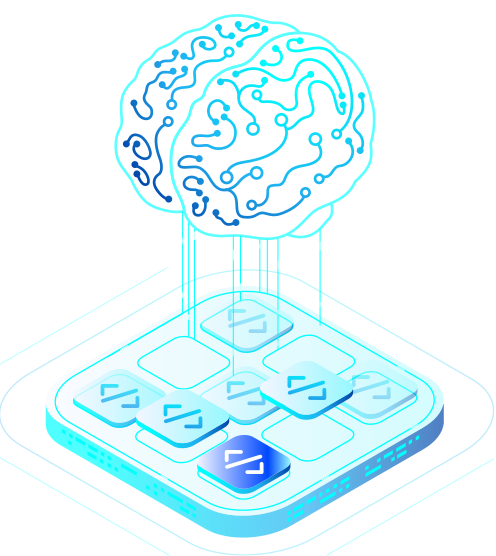
Low-code application platforms (LCAPs) empower stakeholders to develop and deploy apps with minimal coding. Through natural-language prompts and visual drag-and-drop what you see is what you get (WYSIWYG) builders, these platforms enable you to deliver apps much faster than conventional methods.
LCAPs abstract away the complexities in application development, such as the need to engineer a front-end and a back-end for applications. By providing reusable existing components, preconfigured templates, and the ability to script custom code when required, LCAPs accelerate application development by making you focus on the logic instead of the technicalities involved.
Why low-code matters now
According to the IT research firm Gartner's 2025 Forecast Analysis for Low-Code Development Technologies, the low-code market is projected to grow at a 14.1% compound annual growth rate (CAGR) and achieve a market value of $58.2 billion by 2029.
And advancements in AI have further revolutionized the app development landscape. Most LCAPs have hopped on to the AI wave, assuming a role that's more pivotal than ever. With AI, the speed with which LCAPs deliver apps has accelerated from 10 to 100 times that of conventional application development.
The value of AI-powered low-code isn't just to "ship faster", it's to "ship faster without creating a sprawl of shadow IT apps and code comprehension debt that IT will have to clean up later". AI accelerates the build, but the LCAP provides the operational scaffolding, security, and granularity that enterprises require.
This is also where low-code differs from vibe coding and AI-powered code-generation platforms. Those tools turn natural-language platforms into raw code, which is flexible but unpredictable and unreliable. The generated code still needs developer review, debugging, and ongoing maintenance to be production-ready. AI-powered low-code, by contrast, creates apps in a structured environment with prebuilt components, guided workflows, and governed data models. What gets shipped isn't just fast—it's also consistent, secure, governable, and manageable at an enterprise scale.
How we selected the top platforms
We asked ourselves the following questions while choosing the top low-code platforms on this list:
Ease of use
We evaluated whether the platform was easy to use. What are its system requirements? Is it accessed via the web or does it require installing an executable?
We realized that the easier it was to get started with and use the platform, the better the experience of using it will be.
Features
What are the features offered by the platform? Are the features comprehensive and cutting-edge? Does it have AI features? Does it have support for AI-powered application development? Does the platform have visual builders?
Platforms that answered the above questions in the affirmative were shortlisted.
Security and compliance
LCAPs abstract away the complexities in application development, including application security. The platforms we've shortlisted have passed stringent security standards, and they're compliant with global security and privacy regulations such as CCPA, GDPR, and HIPAA. Security-related features like role-based access, audit trails, and single sign-on (SSO) were also included.
Integration capabilities
With AI advancements mandating support for protocols like the Model Context Protocol (MCP), and with new AI tools and software swarming the market, the low-code platforms we shortlisted supported seamless integrations with other platforms and software. They also provide connectors for popular tools and platforms, and provide interfaces for architecting custom connectors easily. Integration support is vital.
Cross-platform deployment
Does the platform support hassle-free deployment to the web and mobile, without additional platform-specific programming required? Does it support progressive web apps (PWAs)? Are native mobile apps a given?
We chose platforms with strong cross-platform deployment capabilities.
Customization and extensibility
Premade templates and reusable components provided by the platform should allow for a degree of customizability, and scripting, custom functions, or APIs to handle the edge cases should be supported. These are quintessential for every business looking to build its own apps on a platform with a degree of customization and extensibility.
Onboarding and customer support
Though low-code platforms come with the claim of simplifying application development, each platform has a learning curve unto itself. This learning curve should be offset by support during the initial onboarding, and continue through onboarding and beyond. Platforms that offer solid onboarding and customer support were chosen.
Pricing
The platform should have simple, straightforward pricing. Its pricing page shouldn't take more than a couple of minutes to read. There should be no hidden costs or caveats. There should be no premium-tier surprises for basic features like integrations or mobile access.
Feature comparison of the best low-code platforms
| Features | Zoho Creator | Microsoft Power Apps | Mendix | Appian | OutSystems | ServiceNow | Salesforce Lightning | Pegasystems | Oracle APEX | Creatio |
|---|---|---|---|---|---|---|---|---|---|---|
| Build applications through natural language prompts | ||||||||||
| Build apps from product requirements documents (PRDs) and workflow diagrams | ||||||||||
| AI-suggested app structure and data models | ||||||||||
| AI agents | ||||||||||
| AI-assisted form and field recommendations | ||||||||||
| Prebuilt AI models for object detection out of the box | ||||||||||
| Custom AI model creation and deployment out of the box | ||||||||||
| AI-driven workflow automation | ||||||||||
| AI-assisted code generation | ||||||||||
| Built-in app IDE | ||||||||||
| Built-in payment integrations | ||||||||||
| Android SDK and iOS SDK | ||||||||||
| Automatic progressive web app (PWA) creation | ||||||||||
| Customizable controls for mobile and tablets |
Disclaimer:
The top low-code platforms
We'll now examine the ten leading low-code application platforms across six dimensions: platform overview, core features, target persona, strengths, weaknesses, and pricing. Pricing reflects publicly available information as of mid-2025–mid-2026 and is subject to change; many platforms also mandate a custom quote.
Check whether Zoho Creator is right for your use case
Book a demo
Zoho Creator
Platform overview
Zoho Creator is Zoho Corporation's low-code application development platform that has been in the industry for two decades. It's an AI-powered platform that allows users to create custom web and mobile applications through natural language prompts and a drag-and-drop interface. The platform facilitates data collection, process automation, analytics, and team collaboration, with native integration across the full Zoho suite and connectors to hundreds of third-party apps. Zoho Creator is a Challenger in the 2025 Gartner Magic Quadrant for Enterprise Low-Code Application Platforms and a Leader in the Nucleus Research LCAP Technology Value Matrix 2025.
Core features
The platform features the CoCreator AI assistant for voice-and-text-driven app building, plus AI skills for natural-language process automation. There's support for PRD- and workflow-diagram-based app creation, AI-suggested data models, AI agents, custom AI model deployment, prebuilt object detection models, AI-assisted code generation, and AI-driven workflow automation. Comprehensive AI agent capabilities are offered by the platform, including the ability to create custom chat agents, in addition to support for creating agents to build and plan apps. Zoho Creator has a drag-and-drop form builder with 30+ field types (including AI fields).
Rich, visually appealing and interactive dashboards can be built using the drag-and-drop dashboard builder. Workflows can be automated visually, and process orchestration can be achieved using the dedicated Blueprints feature. No separate mobile development is required, as native mobile apps are automatically generated for iOS and Android.
The platform also features integrations with built-in business intelligence (BI) and analytics with 40+ report templates. It offers integration with the broader Zoho ecosystem and 1,000+ third-party apps via Zoho Flow. Apps can be deployed to the cloud, on-premises, or through a hybrid approach.
Target persona
The platform has a broad reach across SMBs, mid-market, and enterprise. It has particular strength among existing Zoho customers (such as CRM, Books, People, Desk users) and citizen developers in operations, HR, and field service roles. It can be leveraged by users seeking to build internal tools, ecommerce, and workflow automation across a wide swathe of industries.
Strengths
- Praised for ease of use and accessible drag-and-drop builders.
- User-friendly menus and many prebuilt app templates.
- Strong affordability versus enterprise alternatives.
- Effortless native mobile experience + deep Zoho ecosystem integration.
- Rapid prototyping; quick to engineer operational tools.
Weaknesses
- Customization can feel limited for pixel-perfect UI control.
- Deep UI customization needs JavaScript & HTML/CSS (ZML eases dashboard design).
- Deluge scripting can be tough for non-programmers; hiring Deluge devs is hard.
- Governance & DevOps tooling lags rivals — less mature for large multi-team orgs.
Pricing
- Standard (1 app)/user/monthly
- Professional (unlimited)/user/monthly
- Enterprise/user/monthly
- FlexCustom
- Standard (1 app)/user/monthly
- Professional (unlimited)/user/monthly
- Enterprise/user/monthly
- FlexCustom
A 15-day free trial is available, plus a free tier for individuals or small teams to build a single app.
Choose Zoho Creator if...
- You're an SMB, mid-market, or enterprise organization that values ease of use and a short time to first app.
- You're already in the Zoho ecosystem (CRM, Books, People, Desk) and want deep native integration, plus connectors to 1,000+ third-party apps via Zoho Flow.
- You need native iOS and Android apps generated automatically, with no separate mobile development effort involved.
- You're comfortable with Deluge, ZML, JavaScript, and HTML/CSS when you need to push past the visual builders for deeper customization.
Microsoft Power Apps
Platform overview
Microsoft Power Apps is part of the broader Power Platform suite (alongside Power Automate, Power Pages, and Copilot Studio). Line-of-business users and professional developers can build custom business apps connected to Microsoft Dataverse and a wide range of cloud and on-premises data sources. Recently, the platform has announced support for a reimagined developer experience that combines vibe-coding speed—natural-language app generation at enterprise scale—allowing users to collaborate with AI agents that define requirements, design data models, and deploy full-stack applications.
Core features
Apps developed on power apps fall under two categories: canvas apps and model-driven apps. Canvas apps provide pixel-level UI control, while model-driven apps offer data-centric experiences. Power Apps comes with deep integration support for Microsoft offerings like Microsoft 365, Teams, SharePoint, Dynamics 365, and Azure. Power Platform offers over 1,400 connectors to interface with, and the Power Fx low-code formula language facilitates custom scripting. The platform's AI Builder supports embedded AI/ML, while Copilot provides natural-language prompt-based app development. Stakeholders can exercise enterprise-grade governance of apps developed on the platform through the Power Platform admin center.
Target persona
Power Apps empowers citizen developers and business analysts already in the Microsoft ecosystem. Professional developers can use the platform to build and extend apps via Power Fx, pro-code components, Azure Functions, and Dataverse plug-ins. The platform skews toward enterprises that are already using Microsoft solutions like Microsoft 365, Teams, SharePoint, and Dynamics 365.
Choose Microsoft Power Apps if...
- Your organization already leverages Microsoft products like Microsoft 365, Teams, SharePoint, Dynamics 365, or Azure, and you want apps that integrate natively with those tools.
- Your builders are citizen developers and business analysts comfortable in the Microsoft stack, supplemented by professional developers who can extend apps via Power Fx, Azure functions, and Dataverse plug-ins.
- You need access to one of the industry's largest connector ecosystems.
- You're willing to navigate a multi-layered licensing model (premium, per-app, pay-as-you-go) and budget for Dataverse capacity, AI Builder credits, and premium connector add-ons.
Strengths
- Advanced Copilot AI assistance.
- One of the largest connector ecosystems in the industry.
- Tight Microsoft-stack integration; Embed apps in Teams & SharePoint.
- Named a Leader in the 2025 Gartner Magic Quadrant for Enterprise LCAP.
Weaknesses
- Often needs Power Automate (workflow) + Power BI (reporting), adding complexity.
- Licensing widely seen as confusing — multiple SKUs (premium, pay-as-you-go).
- Add-ons for Dataverse capacity, AI Builder credits and premium connectors compound cost.
Pricing
- Developer Plan (non-production)Free
- Premium per user$20/user/month
- Premium at 2,000+ licenses$12/user/month

Mendix
Platform overview
Mendix is an enterprise-grade low-code platform for building complex web and mobile applications using a model-driven development approach. Founded in 2005 in Rotterdam (US headquarters in Boston), the platform offers support for the entire software development lifecycle with an integrated IDE, and deployment to public, private, and hybrid clouds, or on-premises.
Core features
Studio Pro is Mendix's unified IDE. Originally a desktop-class authoring environment for professional developers, it has since absorbed the simplified, low-code experiences once housed in the stand-alone Mendix Studio (retired in 2023). The same visual model now spans citizen-developer and pro-developer workflows, compiling into runtime apps.
Mendix has the Mendix Marketplace, where developers can access reusable components and connectors.
On the AI front, Maia is Mendix's AI development suite. Real-time recommenders and a conversational builder, Maia Make, live inside Studio Pro for hands-on development; the newer Maia Plan sits upstream in the Mendix Portal, turning project briefs and intake notes into structured, sprint-ready delivery plans.
For governance, Mendix offers Git-based version control and DevOps support. For workflow automation, business process model and notation (BPMN)-style workflow modeling is supported.
Target persona
Mendix targets both business analysts and professional developers. With regards to organization segmentation, Mendix is positioned at enterprise IT organizations and fusion teams in mid-to-large companies (typically 500+ employees) that need to modernize core systems and build business-critical applications across the SDLC.
Choose Mendix if...
- You're a mid-to-large enterprise (typically 500+ employees), seeking to modernize your core systems and build business-critical applications.
- You want Git-based version control and DevOps tooling for enterprise governance.
- You're willing to scale a steep learning curve and premium pricing in exchange for software development lifecycle (SDLC) depth.
- You need a single visual model environment where business users and professional developers can collaborate.
Strengths
- Bridges business & IT with AI-assisted development + lifecycle tooling.
- Recognized by Gartner and Forrester as a leader for professional developers.
- Flexible deployment (public, private, hybrid, on-prem) + deep marketplace.
- Studio Pro fits both citizen and pro developers in one IDE.
Weaknesses
- Steep learning curve; complex logic takes time even for technical users.
- Can feel like overkill for simple apps; performance can suffer with huge datasets.
- Pricing perceived as opaque & expensive, especially for SMBs.
- Licensing model hard to align with project sizes.
Pricing
- Free plan (evaluation)Free
- Standard (1 app)from €900/month
- Standard (unlimited apps)from €2,100/month
- PremiumCustom quote

Appian
Platform overview
Appian is an AI-powered process automation and low-code platform built for enterprise business process management (BPM) and case management. It's a veteran in the low-code space, being founded in 1999. The Appian platform combines case management, automated decisioning, robotic process automation, and digital process automation in a unified suite. It was named a Leader in the 2025 Gartner Magic Quadrant for Enterprise Low-Code Application Platforms and the 2025 Magic Quadrant for Business Orchestration and Automation Technologies.
Core features
The "Appian Guarantee" promises customers a first app delivered in 8 weeks or less. Appian supports visual process modeling with BPMN. Its Self-Assembling Interface Layer (SAIL) UI scripting language can be used to develop responsive interfaces. Its Data Fabric feature virtualizes data from multiple systems without copying it. The platform has AI Copilot and can provide AI-suggested app structures and data models. It has AI agents alongside integrated robotic process automation (RPA), intelligent document processing (IDP), process mining, and portal/external-user support. A mobile native runtime is offered, and deployment options range from on-premises to cloud to hybrid options.
Target persona
Appian is positioned for organizations with complex workflows that require granular customization. Appian is targeted at mid-to-large global enterprises and government agencies, particularly in financial services, insurance, healthcare, and the public sector that automate complex, regulated, end-to-end processes.
Choose Appian if...
- Your primary requirement is automating complex, regulated, end-to-end workflows rather than building general-purpose apps.
- You need unified BPM, case management, RPA, IDP, and process mining in a single package.
- You can afford per-user licensing even for users who only approve or initiate steps.
Strengths
- Accelerated app development, intuitive interface, broad integrations, deep reporting.
- Enterprise compliance certifications: SOC 1, SOC 2, FedRAMP, HIPAA.
- Data Fabric unifies data without extract, transform, load (ETL) — a key differentiator.
- Reliable runtime + strong governance.
Weaknesses
- Pricing widely perceived as expensive, especially for SMBs.
- Per-user licensing stifles adoption for approve/initiate-only users.
- Offline + mobile capabilities still maturing.
- Authoring tool can be slow when building complex apps.
Pricing
- Community editionFree
- Commercial plansContact sales

OutSystems
Platform overview
OutSystems positions itself as an AI development platform for enterprises. It combines visual development with AI agents and code generation. Founded in 2001 in Lisbon, Portugal (now headquartered in Boston, USA), OutSystems is a Leader in the Gartner Magic Quadrant for Enterprise Low-Code Application Platforms and has cloud-native architecture. The modern platform iteration is the OutSystems Developer Cloud (ODC).
Core features
OutSystems provides a visual full-stack development interface for web and mobile that compiles to standard .NET/Java code. OutSystems Mentor is the platform's AI assistant that supports app generation from prompts, code review, and application lifecycle management. Agent Workbench is leveraged for building enterprise AI agents based on customer data. It also has Data Fabric for unified data access across legacy systems and support for a wide library of prebuilt and Forge connectors that make integration with other platforms easy. OutSystems facilitates DevOps with support for built-in continuous integration and continuous deployment (CI/CD), automated testing, and observability. Applications can be deployed to the cloud or to a hybrid hosting space.
Target persona
OutSystems targets professional developers, CIOs, and IT leaders at large enterprises that build business-critical applications at scale, modernize legacy systems, and increasingly deploy AI agents alongside customer-facing apps. The platform is positioned as a tool for technical audiences rather than citizen developers.
Choose OutSystems if...
- You're a large enterprise that requires business-critical applications at scale and want to modernize your existing legacy architecture.
- Your primary builders are professional developers, CIOs, and IT leaders, not citizen developers.
- You're willing to engage partners and face a steep learning curve.
- You want to roll out AI agents alongside customer-facing apps and need MCP support plus a broad library of prebuilt connectors.
Strengths
- Significantly reduced development time for bespoke apps; rapid delivery cycles.
- Generates standard, open code — reduces lock-in concerns.
- Strong security & compliance posture (SOC 2, FedRAMP).
- Mature mobile development support + flexible deployment.
- No per-developer-seat charge — costs driven by app/end-user metrics.
Weaknesses
- Pricing perceived as complex and expensive, especially for SMBs and growing user bases.
- On going costs and licensing fees can be hard to justify at times.
- Steep learning curve; a delivery partner is often recommended.
- Vendor lock-in concerns around the proprietary visual language; UI customization can hit limits.
Pricing
- Free evaluation (10 days, up to 100 users)Free
- Developer Cloudfrom $36,300/yr

ServiceNow App Engine
Platform overview
ServiceNow App Engine is the low-code/no-code (LCNC) development platform bundled within the ServiceNow AI platform. This is the same platform that powers ServiceNow's IT Service Management (ITSM), Human Resources Service Delivery (HRSD), Customer Service Management (CSM), and IT Operations Management (ITOM). App Engine helps users ranging from citizen developers to pro developers build, automate, and innovate intelligent workflow applications, with apps, AI, data, and workflows operating on a single enterprise-grade platform.
Core features
The platform's visual app composer is App Engine Studio. For workflow automation, Flow Designer is the tool, and for modern interface engineering there is a robust UI builder. The platform's IntegrationHub offers thousands of "spokes" for third-party connectivity. AI support comes in the form of Now Assist for Creator that facilitates GenAI powered natural-language app and flow generation. The platform also supports PRD- and workflow-diagram-based app creation and custom AI model deployment. For granular governance, the App Engine Management Center is offered, which enables governance, guardrails, and automated reviews. AI agents and gentic capability support is also available.
Target persona
Both citizen developers and pro developers are targeted, with strong IT governance guardrails. The platform's appeal also extends to existing ServiceNow customers extending the Now Platform, typically large enterprises with established ITSM, HR, and customer service deployments who want to digitize departmental processes and build internal workflow apps
Choose ServiceNow App Engine if...
- You are already invested in ServiceNow with established ServiceNow ITSM, HRSD, CSM, or ITOM deployments.
- Your use cases are primarily internal workflow apps rather than polished, consumer-facing experiences.
- You can meet ServiceNow's enterprise commercial thresholds (often referencing six-figure minimum orders).
- You want strong IT-led governance.
Strengths
- Direct access to ServiceNow's unified Now Platform , apps inherit ITSM-grade governance, integration, and AI.
- Connects natively to existing ServiceNow data.
- Strong governance via the App Engine Management Center, suited to regulated enterprises.
Weaknesses
- Significant lock-in to the ServiceNow platform; ROI depends on already being a customer.
- High licensing costs with opaque pricing and no public list price.
- Complex implementation and customization difficulty.
- Less suited to pixel-perfect, consumer-facing apps.
Pricing
- Standard / Professional / Enterprise tiersContact sales
- Typical commercial profileSix-figure annual
Salesforce Lightning
Platform overview
Salesforce's low-code platform (recently rebranded under Agentforce 360 Platform branding) extends Salesforce CRM with declarative tools to build custom apps, automations, and AI agents on the same metadata foundation. The platform combines various products, including Lightning App Builder, Flow Builder, Apex, and Lightning Web Components, with reusable metadata so that an asset defined once can be reused everywhere across the Salesforce ecosystem.
Core features
- Salesforce Einstein and Agentforce AI for AI-assisted app building.
- Support for AI-assisted code generation across declarative and pro-code tools.
- Support for custom AI model creation and deployment and AI-driven workflow automation, though no support for PRD- or workflow-diagram-based app creation or AI-suggested data models out of the box.
- Lightning App Builder for declarative page and dashboard development.
- Flow Builder for workflow and process automation.
- Schema Builder for data modeling on custom objects.
- Salesforce Apex (Java-like server logic), and Lightning Web Components (LWC) for pro-code bespoke extensions.
- Built-in security, sharing, and reporting.
- Mobile-native capabilities.
- Tight integration with Salesforce's Sales Cloud, Service Cloud, Marketing Cloud, and Data 360.
Target persona
The primary intended audience is existing Salesforce customers, primarily mid-to-large enterprises in sales, service, and marketing functions. Also targeted are Salesforce admins and developers who are tasked with extending the CRM offering to broader business processes. The platform sees heavy adoption among consulting partners and independent software vendors (ISVs) building on AppExchange.
Choose Salesforce Lightning if...
- You're an existing Salesforce CRM customer and want to extend Salesforce Sales, Service, Marketing, or Data Cloud with custom apps.
- Your team consists of Salesforce admins, Apex developers, or Lightning Web Components developers.
- You want apps to inherit Salesforce's metadata, security model, and sharing rules by default.
- You can afford Salesforce's pricing that scales aggressively with users and editions.
Strengths
- Organizations already in the Salesforce ecosystem reap major benefits.
- Apps inherit shared metadata, security model & platform services by default.
- Vast AppExchange partner ecosystem.
- Einstein + Agentforce provide a strong AI roadmap.
- Declarative (Flow, App Builder) + pro-code (Apex, LWC); Gartner Leader 2025.
Weaknesses
- Pricey— costs scale aggressively with users and editions.
- Full extensibility gated behind higher tiers.
- Apex and LWC carry a steep learning curve.
- No appeal without an existing Salesforce footprint.
Pricing
- Platform Starter$25/user/month
- Platform Plus$100/user/month
- EnterpriseContact sales

Pegasystems
Platform overview
Pega Platform is Pegasystems' AI-powered low-code offering, aimed at AI-driven BPM and case management. Founded in 1983, the publicly traded Pegasystems' latest offering is Pega Infinity '25, released in 2025. It boasts AI, low-code, and automation features across products like Pega Cloud, Pega Platform, Pega Customer Decision Hub, Pega Customer Service, and Pega Sales Automation.
Core features
Pega Blueprint is the platform's AI agent that can generate application designs from natural-language input or legacy artifacts like documents, images, videos, and process diagrams. It supports PRD- and workflow-diagram-based app creation, AI suggested data models, custom AI model deployment, AI-assisted code generation, and AI-driven workflow automation. The platform has a rules-based architecture and has broad enterprise system integration capabilities. Apps can be deployed on Pega Cloud or self-hosted with certifications across major public clouds.
Target persona
Pega targets large enterprises with high-volume, complex, regulated processes in sectors like financial services, insurance, telecommunications, healthcare, and government.
Choose Pegasystems if...
- You need to run very high-volume, complex, regulated processes that demand AI-driven decisioning.
- Your business process workflows have deep branching logic that simpler platforms can't handle effectively.
- Your organization has the bandwidth to invest in a long onboarding cycle and Pega-specific talent acquisition.
- You aren't seeking optimization while prototyping or while building simple departmental apps.
Strengths
- Noteworthy AI-driven decisioning capabilities
- Strong vertical templates for financial services, insurance, and healthcare
- Industry-leading BPM and case management for genuinely complex, branching workflows
Weaknesses
- Steep learning curve; onboarding new developers takes time, making talent harder to hire
- Significant, complex licensing costs, especially when expanding to new business units
- Process-rigid , not suited to fast prototyping or simple apps
Pricing
- Free trial / community editionFree
- Enterprise editionCustom quote

Oracle APEX
Platform overview
Oracle Application Express—APEX—is Oracle's low-code platform built directly on Oracle Database. It's an enterprise application platform designed for building secure, scalable web and mobile applications, with apps inheriting reliability, governance, and security from Oracle AI Database and Oracle Cloud infrastructure. Oracle APEX was named a Leader in the 2025 Low-Code Application Platform Technology Value Matrix by Nucleus Research.
Core features
On the AI front, Oracle APEX has an AI-powered application generator and offers GenAI-assisted development, AI agents, and AI-assisted form and field recommendations, with APEX Advisor providing AI-driven code and security review. AI-assisted code generation and AI-driven workflow automation are supported, but PRD- or workflow-diagram-based app creation or custom AI model deployment aren't supported out-of-the-box.
The Oracle Database base means that the platform offers native SQL and PL/SQL access. The browser-based declarative IDE with drag-and-drop page design is robust. The platform provides built-in components for forms, reports, charts, dashboards, and data visualization. It has a universal theme for building responsive, accessible UIs. App extensibility is possible through JavaScript, CSS, and REST services, and security features include built-in measures for preventing cross-site scripting (XSS) and SQL injection protection. Oracle APEX Advisor offers code/security review.
Target persona
Oracle APEX is a natural fit for organizations with existing Oracle Database investments, particularly enterprise IT teams, internal developers, database administrators (DBAs), and SQL and PL/SQL practitioners building data-driven internal apps, analytics dashboards, and departmental tools. The platform is particularly common in industries like financial services, government, and large enterprises with on-prem Oracle footprints.
Choose Oracle APEX if...
- You already have Oracle Database licenses and want a low-code platform at no additional cost.
- You want to build data-driven internal apps, analytics dashboards, and departmental tools.
- Your developers specialize in SQL and PL/SQL.
- Citizen-developer reach and a rich marketplace ecosystem are less important for you than the depth of database integration.
Strengths
- Included at no additional cost with Oracle Database , no per-user, per-developer, or per-app fees.
- Tight database integration delivers exceptional performance at scale.
- Deployment flexibility (on-prem, OCI, Autonomous AI Database).
- Mature, stable platform with a large, global developer community.
Weaknesses
- Much weaker appeal without an existing Oracle Database deployment.
- Pricing advantage disappears if DB licensing must be acquired separately.
- UI flexibility more constrained than dedicated front-end frameworks.
- Best for SQL/PL/SQL devs — limits citizen-developer reach; smaller ecosystem than Microsoft, Salesforce, or Mendix.
Pricing
- Included with Oracle DatabaseFree
- Managed APEX Servicefrom ~$122 /month
- Always Free tierFree

Creatio
Platform overview
Creatio is a low-code/no-code platform combining CRM applications and BPM with native AI capabilities. It has been recognized as:
- A Leader in the 2025 Gartner Magic Quadrant for B2B Marketing Automation Platforms (fifth consecutive year).
- A Visionary in the 2025 Magic Quadrant for Sales Force Automation Platforms.
- The only Leader in the 2024 Forrester Wave: Low-Code Platforms for Citizen Developers.
- A Niche Player in the 2025 Gartner Magic Quadrant for Enterprise LCAP.
Core features
Creatio.ai, a predictive, generative, and agentic AI, is included in all Creatio plans. Creatio AI Studio can be used for building and governing AI agents. It supports AI-suggested data models, custom AI model deployment, AI-assisted code generation, and AI-driven workflow automation. It doesn't support PRD- or workflow-diagram-based app creation. Creatio Business Studio covers process modeling with BPMN 2.0, and apps and pages can be visually designed alongside UI. The platform provides CRM applications for sales, marketing, and service sectors, and industry templates for 20+ verticals like banking, insurance, manufacturing, and healthcare are available. Prebuilt connectors and templates can be accessed via the Creatio Marketplace.
Target persona
Creatio is designed for teams of 10+ users that need serious automation, with a $10,000 minimum annual spend that places it above small-startup territory. It's targeted at mid-market and enterprise organizations needing both CRM and operational process automation in a unified platform. Target industries are financial services, insurance, manufacturing, and B2B services.
Choose Creatio if...
- You're a mid-market enterprise or you have a team of 10+ users with a budget that clears Creatio's $10,000 annual minimum.
- You need a unified CRM plus BPM platform rather than buying them separately.
- You're comfortable with a smaller partner ecosystem than Salesforce, Microsoft, or ServiceNow.
Strengths
- Bundled CRM avoids a separate CRM purchase
- AI features included at no additional cost
- Process-first architecture with a powerful BPM engine for complex branching logic
Weaknesses
- Interface and option set can feel overwhelming initially
- Deeper customization requires technical knowledge
- $10,000 annual minimum rules out very small teams
- Smaller ecosystem and partner network than Salesforce, Microsoft, or ServiceNow
Pricing
- Growth$25/user/month
- Enterprise$55/user/month
- UnlimitedContact Creatio
- CRM apps (Sales, Marketing, Service)from $15/user/month
How the platforms cluster
The ten platforms cluster into some broadly recognizable groups.
Power Apps
Power Apps, which is best when Microsoft 365 (M365) standardization is already in place.
OutSystems & Mendix
High-performance low-code for mission-critical apps with strong governance and AI tooling — at premium price points.
Appian & Pega
Built for complex, regulated workflows in large enterprises. Both are expensive and demanding to learn.
ServiceNow & Salesforce
Strongest when the underlying SaaS — the Now Platform or Salesforce CRM — is already deployed.
Oracle APEX
Ships free with Oracle Database — ideal for SQL and PL/SQL teams.
Creatio
No-code, AI-powered, and ranks strongly among citizen developers.
Zoho Creator
Transparent per-user pricing, native mobile and hybrid deployment, and strong Zoho-ecosystem integration make it suited to everyone from SMBs through enterprises.
Frequently asked questions
Simple internal apps can often be built in a few hours. More complex applications with custom logic, multiple integrations, and bespoke UX typically take a few days to a few weeks.
An ideal low-code platform should be suited for both citizen developers and professional developers. It should have integration capabilities to interface with your existing software stack, varied deployment options (cloud, on-premise, hybrid), automatic scalability, security, and compliance with global standards. Its pricing should be transparent.
Most leading platforms offer prebuilt connectors for popular software, REST and SOAP API support, webhook capabilities, and SDKs for custom integrations.
Common models include per-user (per-developer or per-end-user), per-app, and consumption-based (API calls, workflows executed) pricing. Some hidden costs to watch for include premium connectors and other environment fees, so the total cost of ownership often matters more than the headline price.
Leading low-code platforms offer enterprise-grade security features, including encryption of data at rest and in transit, role-based access control (RBAC), audit trails, and multi-factor authentication (MFA), and are compliant with global security standards like SOC 2, ISO 27001, GDPR, and HIPAA.