Fetch records from Zoho Desk
Table of Contents
Note:
- Each time the zoho.desk.getRecords integration task is executed, it triggers an API request in the back-end. This call is deducted from the external calls limit available for the service from which the task is executed, based on your pricing plan.
- Only actual executions that receive a response (whether success or failure) are counted, not the number of times the task appears in the script. For example, if zoho.desk.getRecords integration task is placed inside a for each task that iterates five times, the number of external calls consumed will be five, even though the task appears only once in the script.
Overview
This task is used to fetch records from the specified Zoho Desk module.
Syntax
<variable>=zoho.desk.getRecords(<orgId>, <module_name>,<fromIndex>,<limit>, <query_value>, <connection>);
where,
| Parameter | Data type | Description |
| <variable> | KEY-VALUE | Variable which will hold the response returned by Zoho Desk. It represents the list of records fetched. |
| <orgId> | NUMBER | specifies the organization ID of the account from which the records will be fetched. This can be found in Zoho Desk Settings > Developer Space > API. 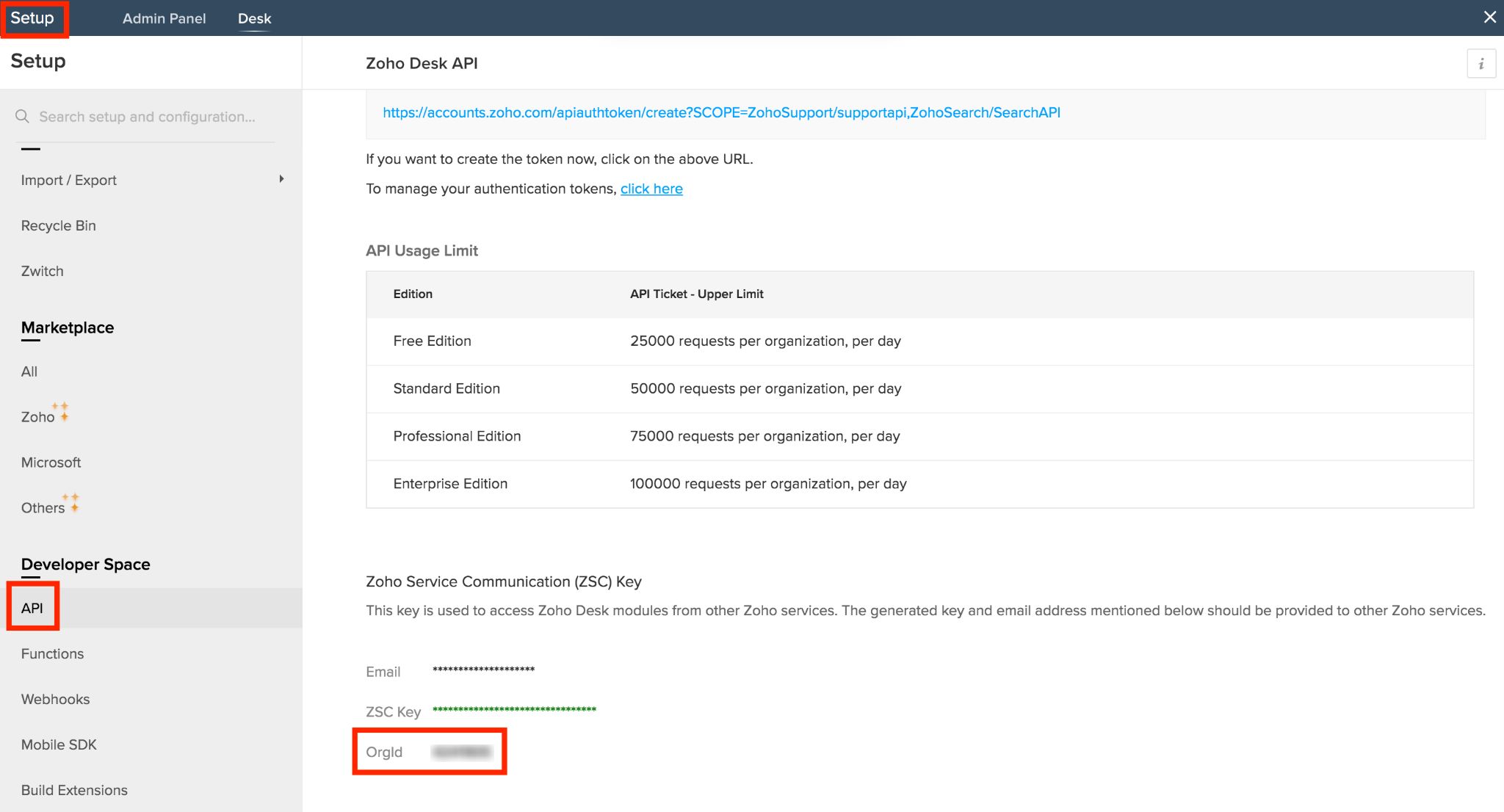 |
| <module_name> | TEXT | specifies the module from which the records will be fetched. The following is the list of supported modules.
|
<from> (optional) | NUMBER | specifies the index of the record from which the records will be fetched. Note:
|
<limit> (optional) | NUMBER | specifies the number of records which will be fetched. Note:
|
<query_value> (optional) | KEY-VALUE | Query to include secondary information related to the selected module. To learn about the applicable values, click here and go to <ModuleName> -> List all <ModuleName> To ignore the secondary information, specify empty map. Note: This is a mandatory param when used in Zoho Creator. |
<connection> (optional)* | TEXT | specifies the name of the connection The scopes which need to be selected are: Note: This is a mandatory param when used in Zoho Creator. |
Note:
In integration tasks, the parameters must be in the defined order as given in the syntax, for the Deluge task to be executed. If you choose to use an optional parameter, ensure that all preceding parameters in the syntax are explicitly specified. If a preceding optional parameter is not required, a null value can be assigned instead, to maintain the defined syntax order.
For example, in the below syntax, options_map and connection are optional parameters:
<variable> = zoho.crm.v8.task (<module_name>, <record_details>, <options_map>, <connection>);
If you want to use the connection parameter, module_name, record_details and options_map must be specified in the
exact order as the syntax. You can assign an empty map to the options_map parameter if it is not required.
Example
The following script fetches all the records from Zoho Desk module - Contacts.
queryValue = {"":""};
response = zoho.desk.getRecords(641XXXXXX, "contacts", 1, 10, queryValue, "desk_connection");
where,
response641XXXXXX"contacts"110"desk_connection"Sample Response
Success Response
The success response returned is of the following format.
{
"data": [
{
"firstName": "Ben",
"lastName": "Williams",
"email": "ben@zylker.com",
"secondaryEmail": null,
"mobile": null,
"phone": "+1 678 XXX XXXX",
"type": null,
"ownerId": "168XXXXXXXXXXXX005",
"accountId": "168XXXXXXXXXXXX097",
"photoURL": null,
"zohoCRMContact": {
"id": "230XXXXXXXXXXXXX044",
"type": "new"
},
"customerHappiness": {
"badPercentage": "0",
"okPercentage": "0",
"goodPercentage": "0"
},
"webUrl": "https://desk.zoho.com/support/smith/ShowHomePage.do#Contacts/dv/bf5c8fXXXXXXXXXXXXXXXXX411872c0a55fabae67fb0",
"id": "168XXXXXXXXXXXX001"
},
{
"firstName": Tom,
"lastName": "Lewis",
"email": tom@zylker.com,
"secondaryEmail": null,
"mobile": null,
"phone": "+1 678 XXX XXXX",
"type": null,
"ownerId": "168XXXXXXXXXXXX002",
"accountId": null,
"photoURL": null,
"zohoCRMContact": {
"id": "230XXXXXXXXXXXXX020",
"type": "contacts"
},
"customerHappiness": {
"badPercentage": "0",
"okPercentage": "0",
"goodPercentage": "0"
},
"webUrl": "https://desk.zoho.com/support/smith/ShowHomePage.do#Contacts/dv/bf5c8fXXXXXXXXXXXXXXXXX6519df7cc50d48844902f0",
"id": "168XXXXXXXXXXXX040"
}
]
}
oURL": null,
"webUrl": "https://desk.zoho.com/support/smith/ShowHomePage.do#Contacts/dv/bf5c8fXXXXXXXXXXXXXXXXX6519df7cc50d48844902f0",
"id": "168XXXXXXXXXXXX001"
}
]
}
To fetch the ID of records from the response, use the following snippet:
var2 = var1.toJsonList();
for each var3 in var2
{
info var3.getJson("id");
}
Failure Response
The failure response returned for incorrect or non-existent organization ID is of the following format.
{
"errorCode":"UNPROCESSABLE_ENTITY",
"message":"The value passed for the 'orgId' parameter is invalid."
}The failure response returned for an incorrect or non-existent record ID is of the following format.
{
"errorCode":"URL_NOT_FOUND",
"message":"The URL you requested could not be found."
}