We've moved past the era where chatbots are just an interface businesses use to convince visitors that someone is available to help or bait them into engagement to reduce the bounce rate. In reality, the information provided by the bots did not fully meet visitors’ needs.
By leveraging Large Language Models (LLMs), the chatbot's ability to understand and respond to complex queries contextually and conversationally has increased significantly, leading to more effective query resolution. This is why we now see advanced chatbots being priced based on the resolutions they provide without any human intervention.
These benefits make it crucial to measure the impact chatbots can have on a business. Those who aren't measuring and tweaking their chatbot strategy are missing out on significant cost savings and revenue growth. This article will discuss how to maximize the benefits of a chatbot, outlining the five steps companies can take to accurately measure its ROI, and what key KPIs they should track.
Key takeaways
Resolution-based chatbot: AI chatbots are moving from an engagement interface to actual query resolution to provide ROI. By contextually solving problems without human intervention, you drastically reduce operational cost and deflection rates, turning your chatbot into a measurable and profitable platform.
Total cost visibility: You must account for the total cost when measuring chatbot ROI, including human resources spent on building, training, deploying, and maintaining, as well as the other hidden costs. Failing to consider any of these aspects will lead to an inflated and inaccurate ROI.
Optimize all along: Measuring and attaining ROI isn’t a one-time achievement. With industry averages reaching 148% to 200%, success depends on a continuous feedback loop. Regularly monitoring drop-off points and enriching your knowledge base ensures that your chatbots bring improved ROI.
Table of contents
Why businesses should measure chatbot ROI
How to calculate chatbot ROI in 5 steps
Metrics and KPIs to track for chatbot ROI
What is chatbot ROI?
Chatbot ROI is a financial metric to quantify the profitability a chatbot brings to a business. It includes measuring the total benefit—the operational cost saved by automating the engagement and the revenue generated/influenced during that engagement compared to the cost of developing, deploying, and maintaining a chatbot.
Chatbot ROI % = [(Saved operational cost + Influenced revenue + Other benefits) - Total cost/Total cost] * 100
A higher chatbot ROI% means that it's performing better and adding value to your business. A lower chatbot ROI% indicates that something needs to tweaked, or your business don't need a chatbot at all.
Why businesses should measure chatbot ROI
Simply put, anything that's costing your business should bring profitability to the table, but not strictly in terms of financial benefits. The non-financial benefits could include freeing up your team's time spent on mundane tasks so they can focus on influencing revenue, or the chatbot providing a contextual and conversational engagement that increases your customers' overall engagement experience. But in totality, it should offer something of value for the incurring cost.
Measuring chatbot ROI will help in three ways:
- Businesses can see its effectiveness and can conclude if it’s worth the money spent on it.
- Even if the results are positive, businesses can look for ways to optimize its performance for increasing the ROI.
- Once your start measuring it'll help you see its contribution over time.
How to calculate chatbot ROI in 5 steps
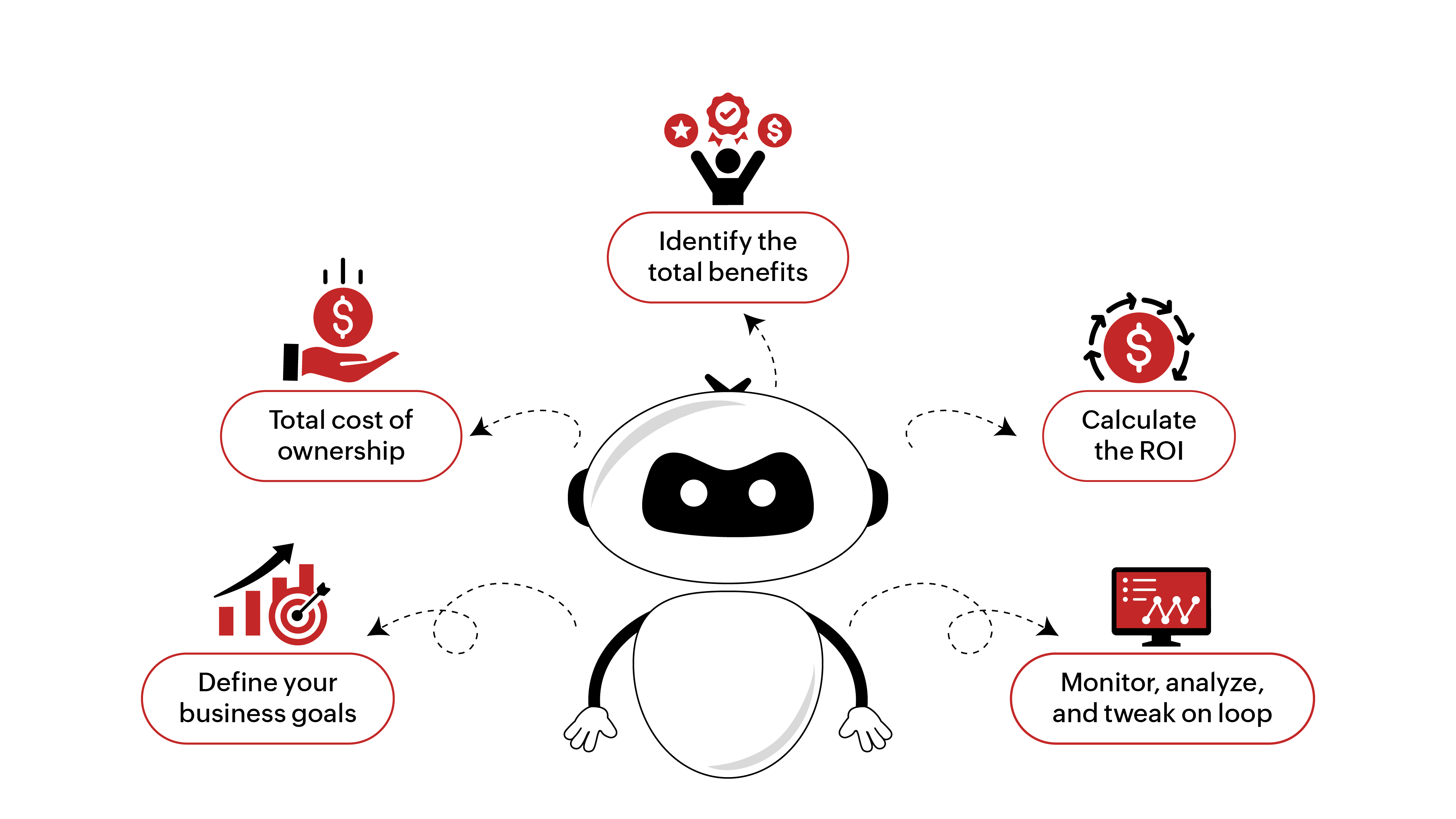
Chatbot ROI can be calculated by following these steps:
- Define the chatbot's business goals.
- Identify the total cost of ownership.
- Identify the total benefits.
- Calculate the ROI.
- Monitor, analyze, and set up a feedback loop for optimization.
Step 1: Define the chatbot's business goals
Before measuring ROI, define your chatbot’s goal. Once you know the 'why,' you will know exactly what to measure.
Related read: How to choose the right chatbot platform
Step 2: Identify the total cost of ownership
To identify the total cost of ownership, you have to consider two categories: the one-time cost of setting the solution up, and the recurring cost of running and maintaining the solution.
| Category | Costs |
|---|---|
| One-time set up cost |
|
| Recurring cost |
|
Step 3: Identify the total benefits
Similarly, to identify the total benefits you get out of implementing a chatbot, you've to consider two categories: Operational and financial benefits.
| Category | Benefits |
|---|---|
| Operational benefits |
|
| Financial benefits |
|
Related read: Benefits of chatbot
Step 4: Calculate the ROI
Now that you know how much you spent to conceptualize, design, build, deploy, and maintain the chatbot, as well as the actual results it got for your team, the ROI can be calculated from the formula mentioned below.
Chatbot ROI % = [(Saved operational cost + Influenced revenue + Other benefits) - Total cost] / Total cost * 100
Step 5: Monitor, analyze, and set up a feedback loop for optimization
Your chatbot ROI is measured. But what's next? What do you do with the data?
According to Fullview’s AI 2025 analysis1, chatbots bring 148% to 200% ROI to organizations, on average. You can compare your ROI with the industry standard and see how you're faring and take follow-up actions as needed.
After identifying the ROI, you can tweak the chatbot to get the maximum value out of it. The chatbot needs to be regularly monitored and analyzed in intervals to see if its performance is improving. This process should be attached with a feedback loop and repeated until you're satisfied with the ROI.
Metrics and KPIs to track for chatbot ROI
To keep track of the chatbot ROI, you need to measure your chatbot's outcomes. The key metrics you should focus on are the operational and business impact metrics, such as:
- Generated leads.
- Resolution rate.
- Revenue growth.
- CSAT.
- Deflection rate.
- User sentiment.
Related read: 14+ chatbot metrics and KPIs
Common mistakes that reduce chatbot ROI
- Goal and action misalignment: As we covered earlier, before even deploying a chatbot, you should have a clear idea on why you want one. Only when the goal is fixed can processes be framed to move towards the goal.
- Complicating the basics: Chatbots are a wonderful piece of tech, but it isn’t a complete replacement for humans to handle every possible edge case. If you deploy chatbots to handle every edge case without understanding their capabilities and weaknesses, you'll be setting up yourself for failure.
- On the engagement front, getting too many information from the visitor, especially at the initial stage where the user is not even in a serious engagement, is not a good practice. This highly impacts drop off.
- Neglecting knowledge base: Chatbots don't work independently. Deploying a chatbot without it having an enriched knowledge base will result in a poor deflection rate, draining both operational expenses and resources.
Finally, you shouldn't gatekeep access to your human agents when your visitors desperately need human support. Not having a human touchpoint when the chatbot is not able to resolve a query is a big no. There should be options to send email or connect with human agents.
How to improve chatbot ROI with Zoho SalesIQ
Zoho SalesIQ offers a chatbot platform that helps you build customized chatbots for your business and deploy them faster. The platform also comes with a bunch of features to help you monitor and improve your ROI.
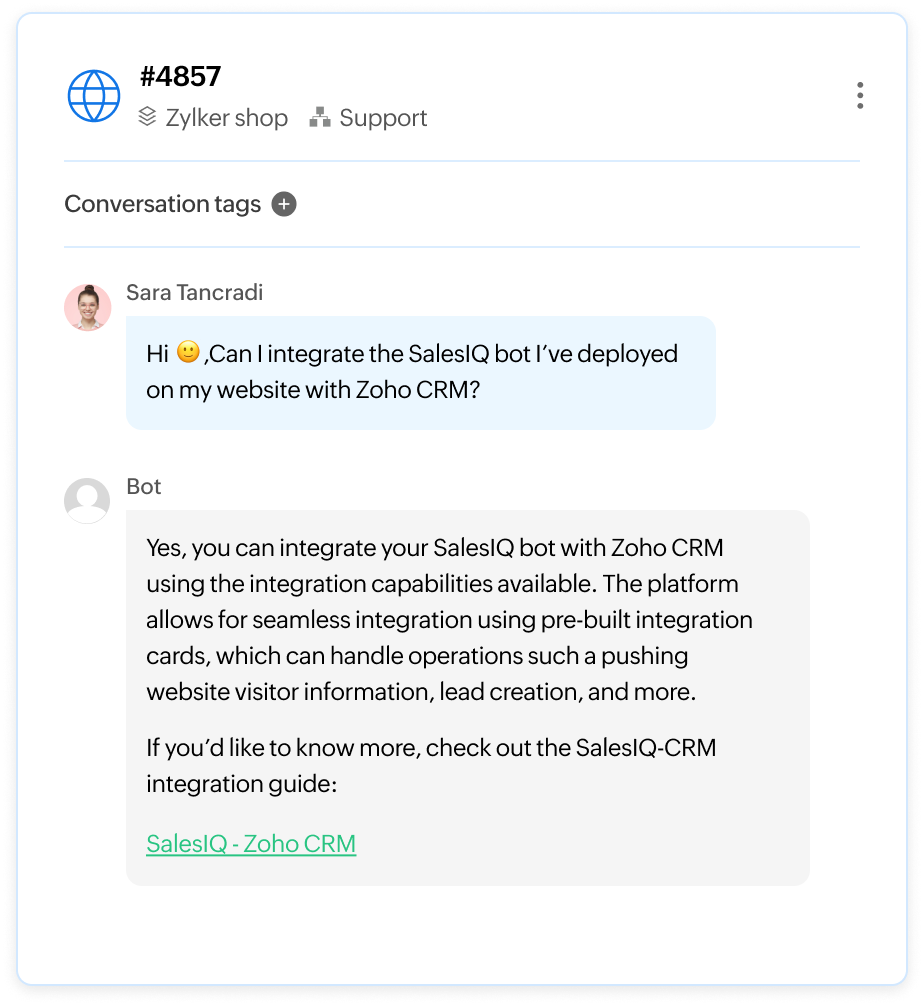
- By deploying SalesIQ's Answer Bot, which is now powered by both Zia and ChatGPT, your visitors will get accurate information in a conversational and contextual manner. It'll improve your accuracy and containment rates and decrease your deflection rate, which allows your human agents to focus on critical tasks.
![customer engagement strategy']()
- The criteria router in the bot is now powered by AI. It can analyze their sentiment, intent, and the topic of conversation and route them to who can solve their issue better.
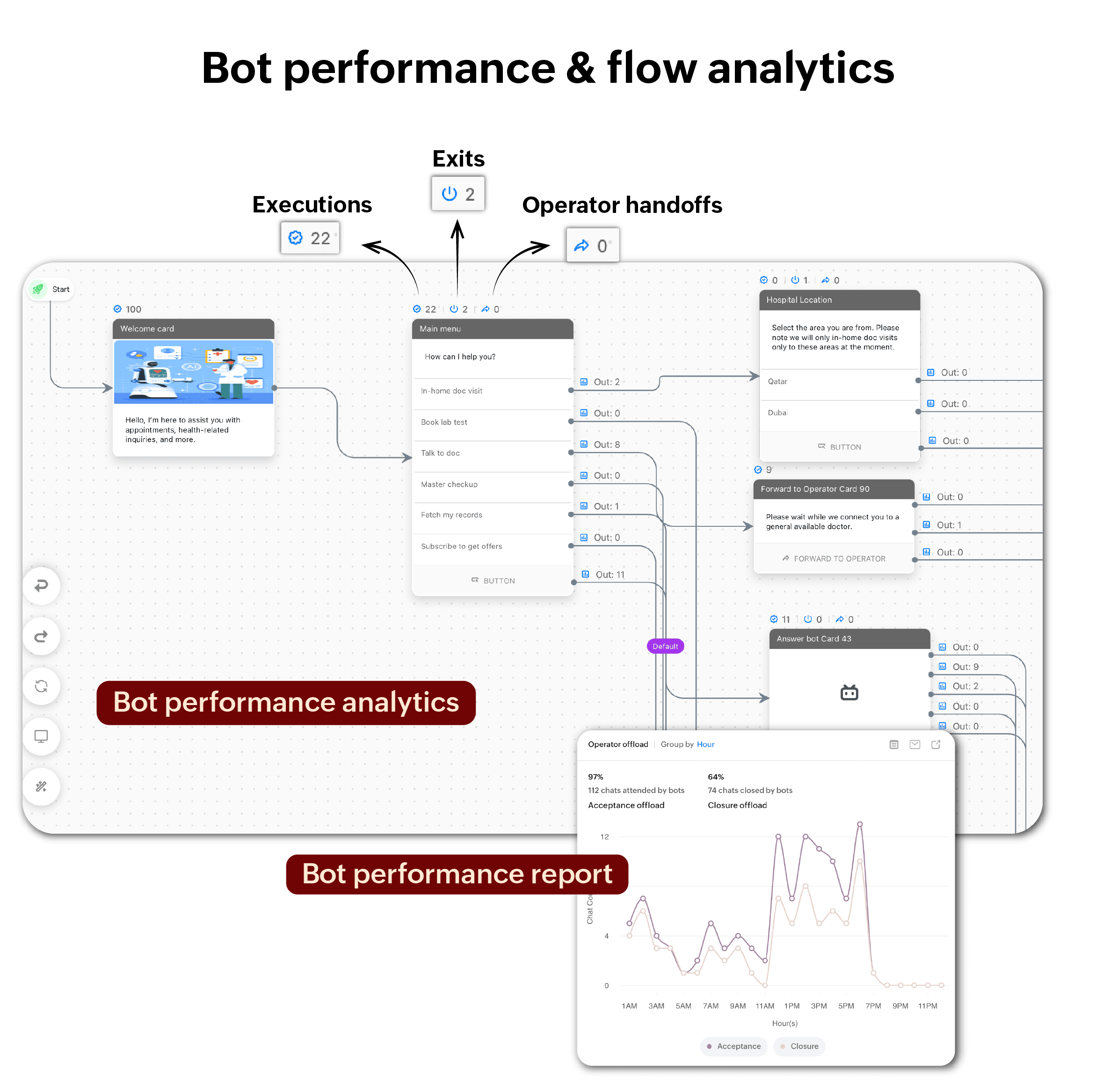
- With Flow reports, where you'll be able to identify precisely what's working and what's not with your chatbot's engagement. You can identify where your visitors are dropping off and how you can fix it.
![customer engagement strategy']()
- SalesIQ also has an extensive Reports module, which will give you complete information about your bots performance, such first response rate, resolution rate, CSAT, and more. By analyzing these metrics, you'll be able to see if the chatbot ROI is positive or not, and make tweaks to further improve them.
Want to see how it works? Book a demo today and our experts will guide you, or sign up for the product and witness it for yourself.
References:
1. Fullview's AI 2025 analysis
FAQs on chatbot ROI
Is a chatbot really worth the investment for small businesses?
Absolutely. For small teams, a chatbot will be a force to reckon with. It handles the 24/7 grunt work of answering repetitive queries and can capture leads, without the massive overhead of a support team. By automating routine queries, small businesses can stop wasting expensive human time on repetitive tasks. With today’s affordable LLM tools, the ROI is fast because they can finally capture the revenue and time that used to slip through the cracks because they were short staffed.
Can chatbots increase sales conversion rates?
Yes, chatbots can increase sales conversion rates. They'll act as your 24/7 sales assistants and do tasks such as instantly qualifying leads, recommending products based on context, answering buyer objections in real time, preventing "cart abandonment", and decreasing bounce rates. Instead of your prospects waiting for a resolution over an email, the bot delivers an answer while the buyer’s intent is highest, ultimately resulting in improved sales conversion rates.
Can chatbots replace human agents entirely?
No. Chatbots cannot completely replace human agents because they cannot provide resolutions for all queries. The goal of chatbots is to handle repetitive, time-consuming, and mundane tasks, leaving the critical ones to your human agents to provide a better experience to all of your visitors.
How soon can one see returns with chatbots?
You can see some instant results, like improved response times and engagement rates, and reduced bounce rates. For financial ROI, most businesses will see the returns within three to six months. If you're a small business, you'll often see returns faster due to lower setup costs, while enterprises may take longer to balance the deep integration expenses.
Why is my chatbot not showing ROI?
It's usually because of one of these three reasons:
- Goal and action misalignment: Without a clear goal, you can’t build a process that actually delivers ROI. So define a fixed goal and process to achieve that goal before deployment.
- Complicating the basics: Chatbots aren't human replacements. Deploying them to handle every complex edge case without understanding their limitations is a guaranteed recipe for failure.
- Neglecting the knowledge base: A chatbot is only as good as its data. Deploying one without a curated knowledge base ensures poor resolution rates and wasted resources.
Fixing these mistakes will help you get positive ROI from the chatbot.
Can chatbots increase sales conversion rates?
You should measure three categories of metrics to measure your chatbot success:
- User engagement metrics: First response time, total active users, engagement rate, voluntary user engagement, number of sessions per user.
- Solution effectiveness metrics: Deflection rate, bounce rate, conversation length, user sentiment, missed utterances, non-response rate.
- Business impact metrics: Generated leads, resolution rate, revenue growth, CSAT.
Read more: 14+ chatbot metrics and KPIs to measure.