
A marketing campaign is typically planned by first discussing the objectives, budget, creative concept, and channels through which the message will be delivered. This is process is far more effective if your team knows who you are trying to get to respond. You might have a profile with an average age or typical job title, but that doesn’t tell you what they need, why they are reluctant to buy, or what information would actually help them decide.
An audience analysis survey lets you answer these questions before the campaign even gets underway. It is about finding out what your potential and existing customers say about their own experience, priorities, and expectations. That then forms the basis of your brief.
The value is in how the answers to those questions inform your decisions. Each question should help you work out who you want to reach, what you actually want to say to them, or how you can make the buying process easier to understand.
This article covers the key questions to ask during audience analysis so that you know how to communicate with your target audience and promote to them effectively.
What is an audience analysis survey?
An audience analysis survey is a questionnaire used to learn about a particular group of people, including their characteristics, behavior, needs, and preferences. It is used before a marketing campaign to identify the problems your audience is trying to solve and the factors influencing their buying behavior.
It is part of direct market research that helps businesses go out and gather information directly from the customer. The U.S. Small Business Administration lists surveys, questionnaires, focus groups, and interviews as ways to learn about a business and its customers.
For campaign planning, the questionnaire should link customer insight to a tangible decision. Information about buying concerns can inform your landing page while information about research habits can tell you where to provide more detailed product content.
Decide what you need to learn before writing questions
Before you go any further and start putting together an audience survey, ask yourself what the real uncertainty is that you are trying to resolve. A very general objective such as "get a better understanding of our customers" is going to lead to a very broad set of questions. A more specific objective, such as "why do our interested prospects not go on to book a demo?", will lead to a much more focused set of questions.
You also need to establish whose experience is relevant. Existing customers can tell you what drove them to buy and whether the experience met their expectations. Prospects who haven’t bought can tell you what their concerns are (and that’s useful). But you need to treat their answers as a separate group from those of the actual customers.
The American Association for Public Opinion Research advises organizations to define clear research objectives and design a sample that represents the population you are studying. In the context of your campaign, this means asking whether the people who are completing the questionnaire are in fact the people you are trying to reach.
Audience survey questions that can guide your campaign
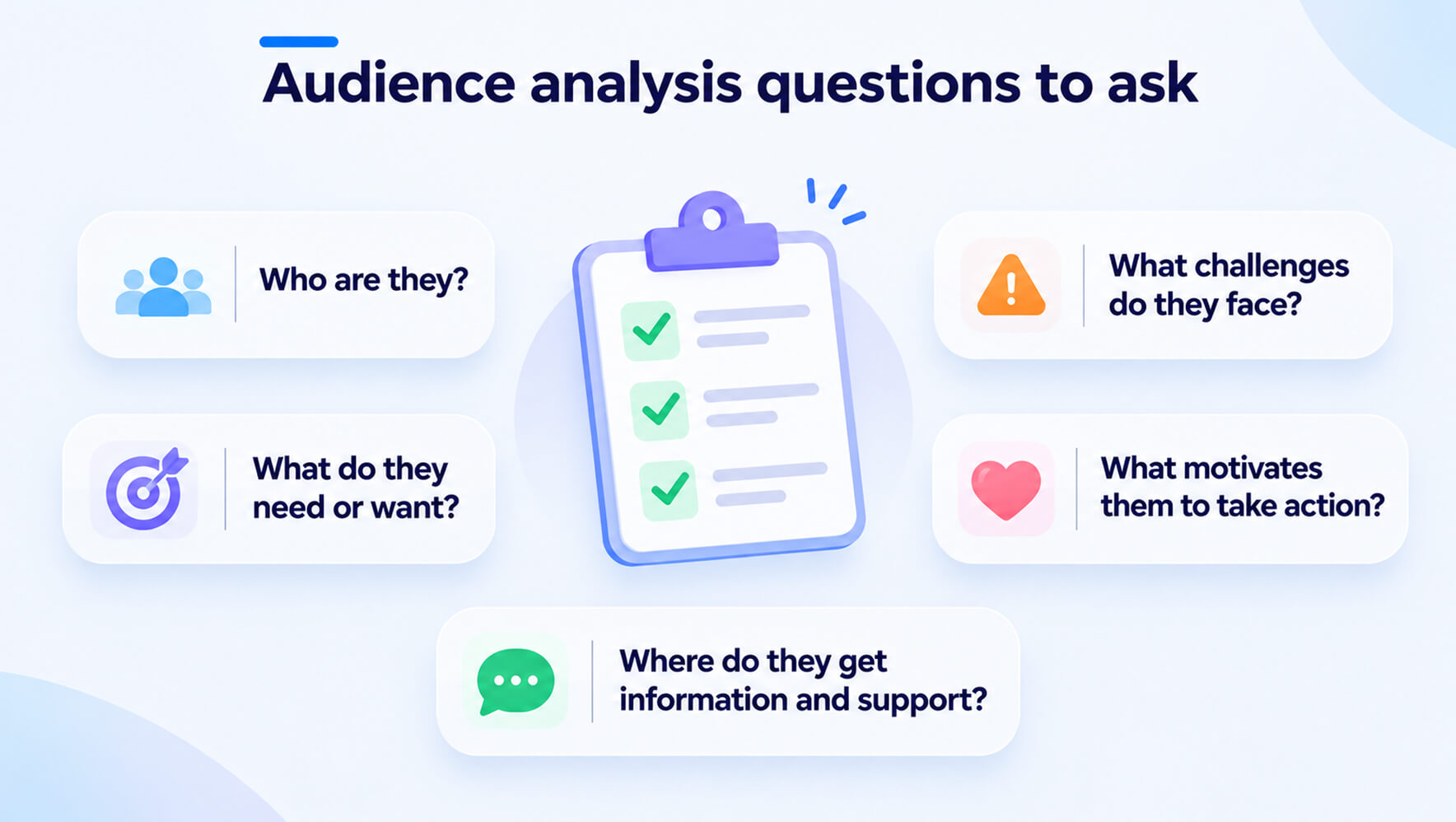
1. Who is your audience and how are they involved in the purchase process?
Your opening questions need to establish the respondent’s relationship to the product category and their level of involvement in the selection process. "When was the last time you bought a product in this category?" is useful because it helps separate people relevant to the campaign from those who may not be. You then want to follow that up with a question about whether they research, recommend, approve, or use the product.
This is especially relevant when multiple people are involved in a purchase. For a B2B campaign, you could use these answers to create separate messages for the person assessing day-to-day usability and the person reviewing the expenditure.
Other background questions should only be included if they are going to have an impact on a decision. If location will affect product availability or delivery, then it is obviously something to consider. If age in any way would not change your offer, your message, or your distribution strategy, then you really need to ask yourself whether it is necessary to collect it at all.
2. What problem is the audience trying to solve?
Once you have established relevance, look at the situation that led the respondent to consider a purchase at all. Questions like "What made you start looking for a solution?" and "What is the primary problem you have with your current approach?" will get them to describe the problem in their own words.
Put this open-ended question in front of the respondent before you present them with a list of the benefits and frustrations. As the Pew Research Centre points out, question order can affect answers, including the issues people cite when they are not given a set of options to choose from.
Look at the responses for any recurring needs or language that could form the basis of your campaign. If people are saying they find it difficult to keep track of their work, for instance, your brief could look at that issue in more detail. The proposed message would of course still need to be checked against what the product does.
3. How are they coping with the issue right now?
A good audience survey would examine the audience’s current approach to the task and what they like about it. "How do you currently deal with this?" followed by "What do you like about that approach?" is a good way of working out what a new solution would be expected to retain.
Then ask what (if anything) would lead them to consider a change. Allow for those who are happy with where they are and have no particular reason to buy.
Use these answers to work out what your campaign actually needs to explain.
4. What factors influence their ultimate decision?
Questions about purchase priorities will go some way toward helping you understand how the respondent weighs their options. Rather than simply asking "was price or quality more important to you?", you could ask "which of the factors was most important to you in your most recent purchase?"
The options should be in the context of your category and could be things such as:
- Total cost
- Ease of use
- Delivery time
- Compatibility
- Support
- Product performance
Where appropriate, you should allow people to add in a consideration that isn’t covered by your list.
These responses can help to inform the emphasis of your campaign. If one particular audience segment keeps coming back to compatibility as a key issue, then your product page could go into that issue in more detail. Think of the results as guidance as to what to test rather than as proof that one benefit will convert every buyer.
5. What stops interested people from buying?
Interest alone won’t tell you whether someone is ready to go ahead. So, your audience analysis survey should focus on what is still unresolved. You might ask "What, if anything, stopped you from buying the last time you looked at that product category?" and then go on to find out what information they needed at that point.
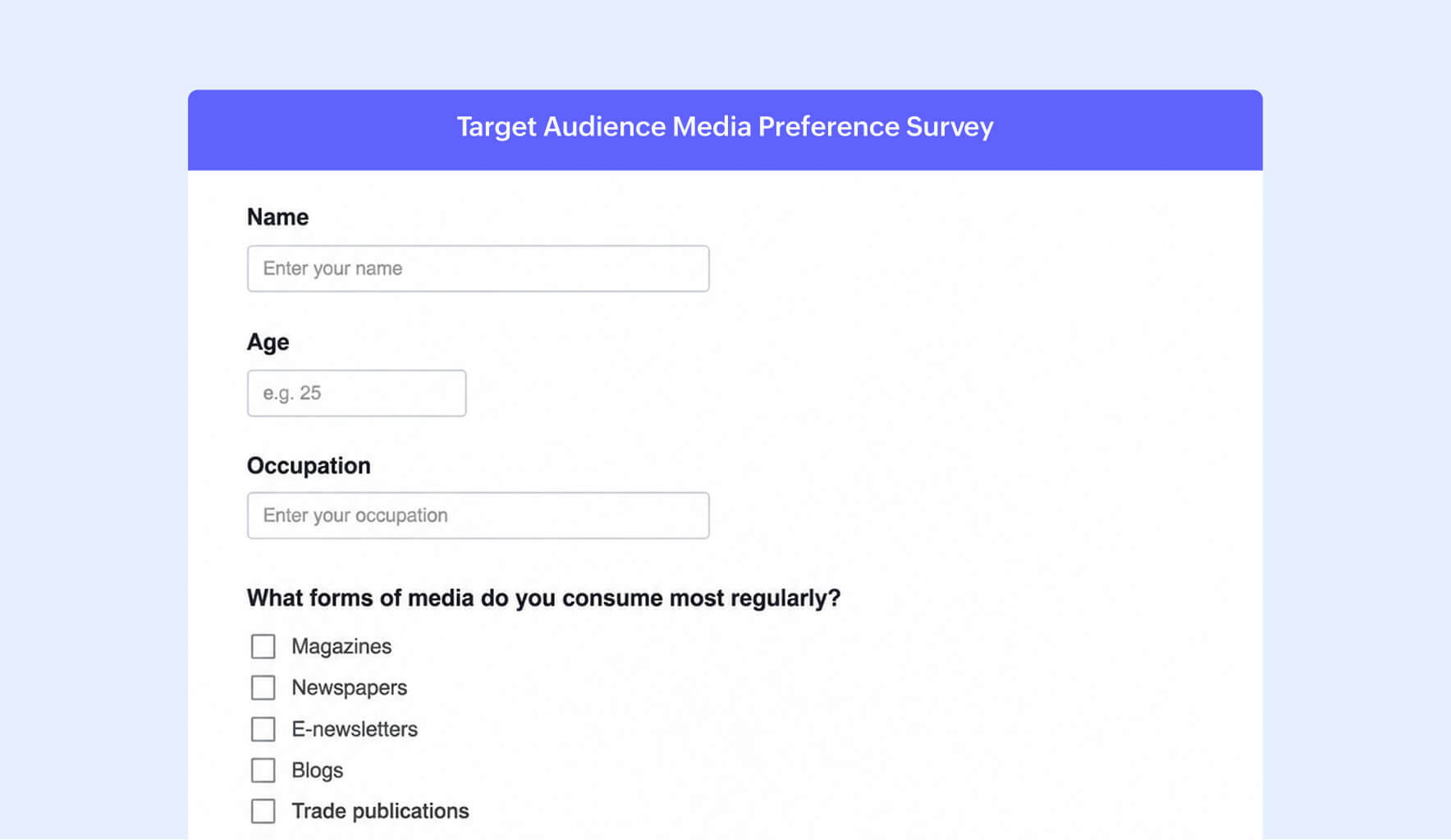
Translate the answers into practical changes wherever you can. If "What’s included in the price" is a common question, that could indicate a need for a clearer explanation on your pricing page. Uncertainty about suitability could lead to a new comparison guide or changes in your product demo.
6. Where do they look for purchase information?
Ask about the sources the respondent used in the purchase process rather than just the ones they like to visit. "Where did you first hear about the product?" is about discovery. "Which sources did you look at prior to making your decision?" is about the research that took place.
Another question you could ask in order to help interpret the answers is ‘Which source was most useful and why?’ Someone may have discovered a product via social media but would then turn to the documentation to determine whether it met their needs.
Use the findings to assign a purpose to each of the proposed channels. Your team can then determine where introductory content is appropriate and where more detailed content is required to compare the survey responses with actual campaign performance.
7. What information would assist them in making a decision?
Focus on what the audience needs to understand. What was hard to compare? What questions still remained? What would have helped the respondents in their assessment of suitability?
Once you have established the information requirement, ask how they would like to get it. A demo, a written guide, a spec sheet, or a chat with a specialist could all be appropriate in different circumstances.
This gives your content team a much clearer brief. A request for a video is far more useful if you know precisely what question it is meant to answer and what the viewer is meant to walk away with.
Audience analysis survey example: A subscription campaign
Think of a meal subscription business running a campaign aimed at working professionals. In this example, the initial plan is to focus on menu variety. But they run a survey with prospective customers before they even start the creative.
The survey looks at how people plan their weekday lunches, what they find difficult about that, and what worries them about a subscription. The answers might reference the difficulty of forecasting their needs in advance and concerns about being able to stop deliveries at any point.
The team could use those findings to test a message around subscription flexibility, supported by clear information on how pausing the subscription works. Menu variety could remain part of the offer, with the key message addressing the concern the research raised.
The survey has given us a testable direction. The campaign results will need to tell us whether that direction in fact leads to more purchases.
Prepare the survey and put the findings to work
Before you distribute the questions, make sure they are neutral and that each one addresses a single issue. "How affordable and convenient is our service?" combines two separate judgments. Pew Research Centre has guidance on why such careful phrasing matters when you are trying to measure people’s opinions.
Relevant follow-up sections can be shown selectively via Zoho Survey’s page skip logic. You can ask a non-buyer about their hesitation rather than asking them to rate the delivery. As the AAPOR recommends, pretest your questionnaire with people who are similar to your actual target respondents.
When responses arrive, examine meaningful audience differences using tools such as Zoho Survey’s cross-tab reports, while keeping respondent numbers and recruitment methods in view.
Your final campaign brief should show how the findings informed the audience, message, supporting content, and proposed tests. An audience analysis survey earns its place in planning when the responses lead to clearer, better-supported decisions about what you will put in front of customers.