
Imagine a business watching people walk away without buying. Should they be talking to the customers? Should they be tracking the frequency of this? Should they be trying a faster checkout? Each path adds a different piece to the puzzle. If you are asking the wrong question, you could end up with mountains of data and still be utterly confused about what to do.
Exploratory research uncovers possibilities, descriptive research documents patterns, and causal research investigates cause and effect. Experimental research tests changes under planned conditions.
These categories overlap. The first three describe research purposes, while experimental design describes an approach often used to investigate causation. In this article, we will discuss these different types of research design in detail and learn when and how to use them.
What is research design?
Research design is your plan for answering the research question. It is the way you bring together your objective, the population or data you are looking at, the information you are going to collect, and the way you interpret the findings.
Interviews, surveys, and observations are all part of your toolkit. The design tells you why you have chosen those particular methods and what kind of answers they can give you.
What is exploratory research?
Exploratory research is your first look at a subject in a state of uncertainty. It is about identifying the right questions, getting a handle on vaguer ideas, and generating ideas for further investigation.
In his research methods text, Anol Bhattacherjee describes exploration as a way to get to grips with something you don’t know much about and to determine whether it is worth further work.
Exploratory research is useful when you are still trying to understand what is happening. You might ask, “Why are people behaving this way?” or “Is there something we have overlooked?” You can refine your questions as you learn more and explore ideas you hadn’t considered.
Exploratory research methods
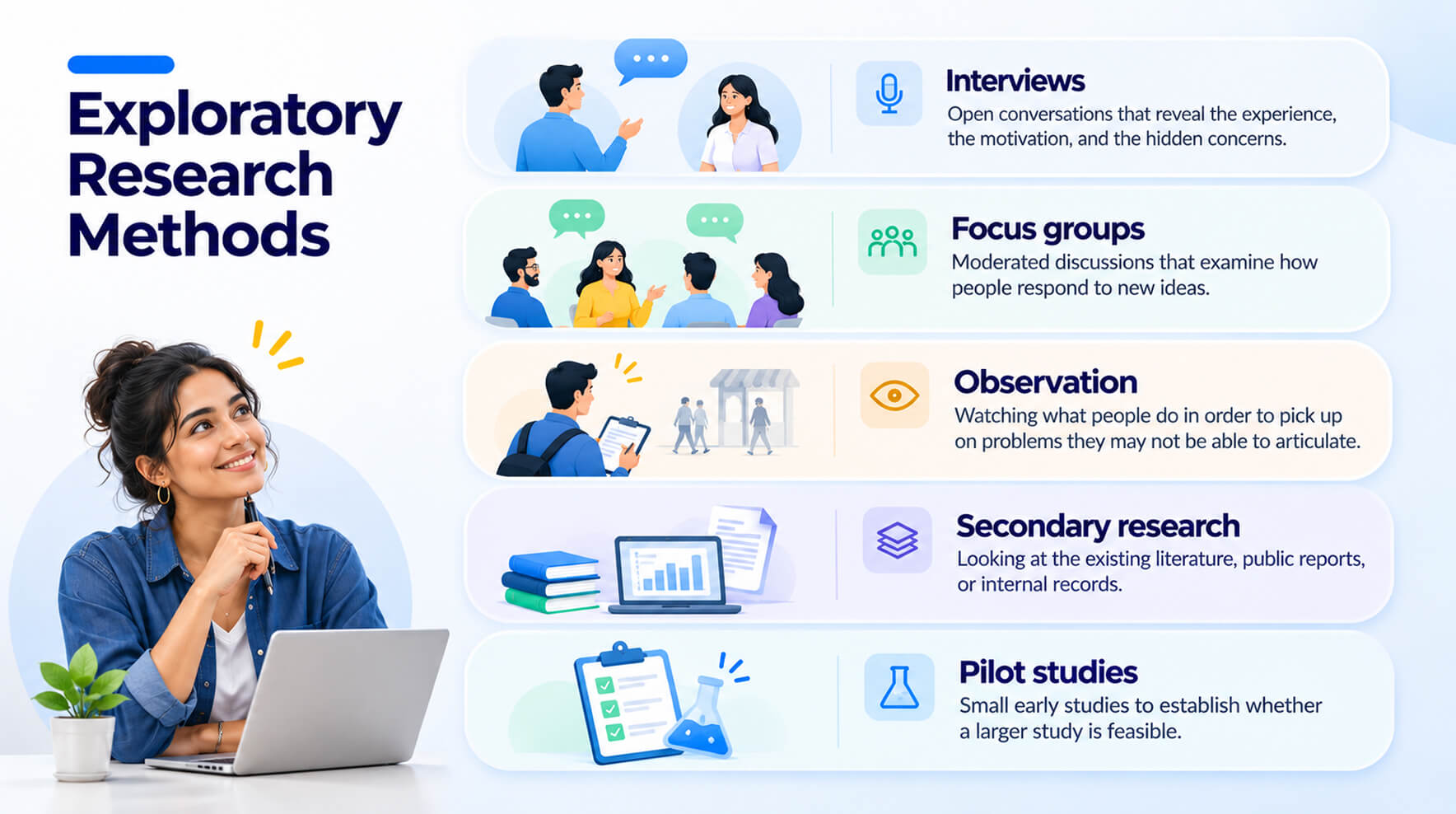
Common exploratory research methods include:
- Interviews: Open conversations that reveal the experience, the motivation, and the hidden concerns.
- Focus groups: Moderated discussions that examine how people respond to new ideas.
- Observation: Watching what people do in order to pick up on problems they may not be able to articulate.
- Secondary research: Looking at the existing literature, public reports, or internal records.
- Pilot studies: Small early studies to establish whether a larger study is feasible.
For instance, an online store could talk to people who left items in their cart. These customers might be complaining about surprise shipping fees, payment problems, or confusing return policies.
These interviews point to some of the reasons. They don’t show how widespread these concerns are across the customer base.
Strengths and limitations
Exploratory research can uncover questions a fixed questionnaire might not address. The sample is often quite small and may be selected deliberately. So, it is not necessarily representative of the whole population. The findings are generally just the beginning (and not conclusive evidence).
What is descriptive research?
Descriptive research carefully examines the characteristics, behaviors, or circumstances of a group or situation.
Descriptive research answers questions about who, what, where, when, and how much. It can tell you how often people shop, what device they use, and how satisfaction varies by location.
The US Office of Research Integrity says a descriptive study is one that collects information (it doesn’t intervene in any way). It could be a study of people at a single point in time or it could be a longitudinal study.
Descriptive research methods
Standard types of descriptive research are structured surveys, observation, and the use of existing records.
You can use surveys to find out what people say they prefer. You can use observation to record behavior in a given situation. Transaction records show how often people buy and how much they spend. A cross-sectional study takes information at a single point in time. A longitudinal study looks at the same people or groups over time to see how things change.
For a retailer, descriptive research could examine where people abandon checkout and how that varies by device. A survey could also identify what problems customers encountered.
Strengths and limitations
Descriptive research tells us what is happening. Its value depends on good measurement, appropriate sampling, and reliable data. But just seeing a pattern doesn’t prove cause and effect. If more people are leaving on mobile, it doesn’t necessarily mean the mobile interface is the problem.
What is causal research?
Causal research examines whether changing one thing affects another and why.
Causal research does more than just establish a link. It asks what would happen if you made a change instead of an alternative, and what would explain any difference.
Would showing the shipping fee earlier reduce checkout abandonment? That is a question about the impact of the change rather than simply a question of what the customer thinks about the change.
Guides on studying causal effects will tell you why these questions are so difficult and why they require such careful planning. Simply adding more variables to your analysis won’t make your conclusions causal.
Causal research methods
Causal research uses randomized experiments (or if that is not feasible, appropriate quasi-experimental methods).
For example, if a policy is introduced in some areas, you can compare the changes that occur in those areas to the changes that occur in areas where the policy isn’t in place. These comparisons, of course, rest on assumptions about what would have happened without the policy.
You can also use observational data for causal analysis if the design and assumptions are correct. The key challenge is confounding variables, where another factor affects both the suspected cause and the outcome. This can make the relationship look stronger or weaker than it really is.
Strengths and limitations
Causal research is what enables you to work out which actions lead to better outcomes. The key is to make credible comparisons. If a retailer changes its checkout during a major sale, it can’t assume the increase in purchases is due to the new checkout. Discounts, more foot traffic, or the time of year could all be factors.
What is experimental research?
Experimental research is where the researcher deliberately makes a change and then measures the outcome.
An intervention (treatment, procedure, or program) is deliberately introduced into an experiment. Researchers use control and random assignment to determine whether the intervention caused the observed change.
That is why experimental research is so important for answering causal questions. Rather than a separate research purpose, it is a method for investigating cause and effect.
How an experimental research design works
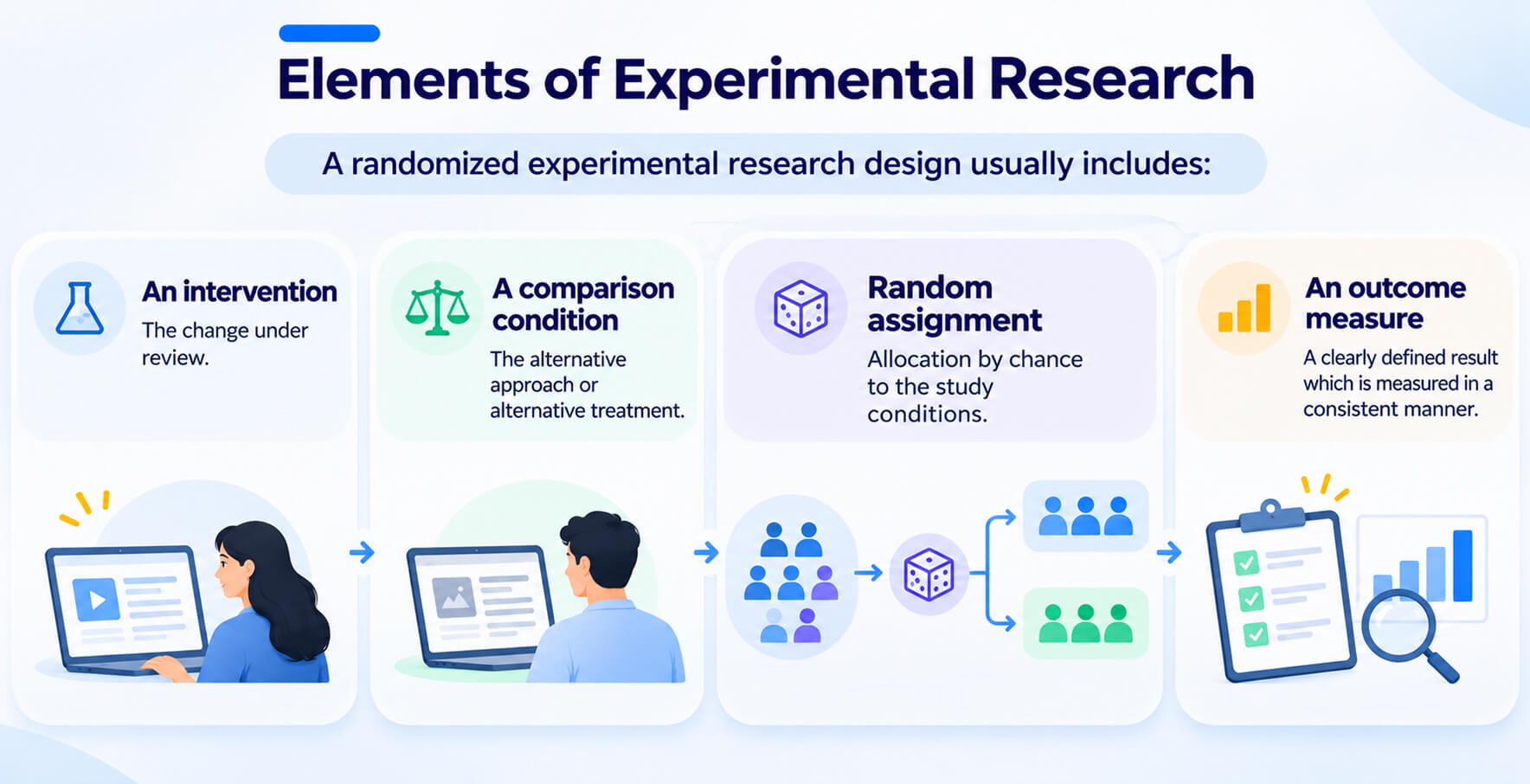
A randomized experimental research design usually includes:
- An intervention: The change under review.
- A comparison condition: The alternative approach or alternative treatment.
- Random assignment: Allocation by chance to the study conditions.
- An outcome measure: A clearly defined result which is measured in a consistent manner.
NIST’s guidance on fully randomized designs states that treatment levels are randomly allocated to experimental units.
For example, a website visitor could be randomly shown either the current checkout or one which shows the shipping fee earlier. You would measure purchase completion in the same way for both groups.
This would be a standard experiment, following a protocol and collecting enough data to detect a real difference.
Strengths and limitations
Well-designed experiments give you stronger causal results by making the comparison groups as similar as possible. Randomization helps reduce bias but doesn’t always produce perfectly balanced groups.
Experiments can be expensive or difficult to carry out. Findings from one location, one group, or one point in time may not be generalizable. Poor data, inconsistent treatments or incorrect measures can all undermine the results.
What is causal comparative research?
Causal comparative research examines existing groups to understand why their outcomes differ. It is often called ex post facto. It is not an experiment because the groups already exist and participation has already occurred. A University of Kansas guide on comparison group designs describes comparing participants with similar non-participants when assignment isn’t random.
For instance, a company might compare the performance of staff who voluntarily completed training in the past with those who didn’t.
This isn’t a randomized experiment, because people weren’t assigned to attend. Those who attended may have differed in motivation, experience, or the level of support they received from their managers before the training.
Matching groups or adjusting for known differences can help to produce better comparisons. There may still be unknown differences, though. Despite the name, causal comparative research cannot establish cause and effect on its own.
How to choose the right research design
Start by thinking about what decision your research is going to support. If you are not quite sure what the problem is, then start with exploration. If you need to know how big the problem is, then you will need a descriptive approach.
When you are thinking about making a change, ask a causal question. If you can assign groups, then go for an experiment. If you can’t, then see if some other design can still give you a decent comparison.
One project could involve several designs. Interviews might identify a checkout problem, descriptive analysis could quantify its scale, and experiments could test a potential fix. Pick the design that enables you to achieve your objective and be very clear about its constraints. Good research gives decision makers evidence to draw on, but it won’t go beyond what it can demonstrate.
An example from daily life
An online retailer interviews shoppers who abandoned their carts to understand why they left. The conversations reveal possible concerns, including unexpected shipping fees, payment failures, and unclear return policies. These findings help the retailer decide what to investigate further. The online retailer employs Exploratory Research here.
The retailer analyzes checkout records to measure how often shoppers abandon their carts. It compares abandonment rates across devices, payment methods, and checkout stages. This reveals patterns (such as higher abandonment among mobile users) without establishing the causes. The retailer uses Descriptive Research methods for this.
Later, the retailer investigates whether displaying shipping fees earlier reduces abandonment. It could compare changes in abandonment across stores that introduce the update and comparable stores that do not. A credible causal conclusion depends on accounting for other explanations, such as differences in promotions or customer groups. This is Causal Research in action.
Also, to try out something new, the retailer randomly assigns website visitors to two checkout versions. One displays shipping fees early, while the other shows them at the usual stage. Comparing purchase completion rates helps assess the change’s effect. This experiment also serves a causal research purpose. This is an example of Experimental Research.
Now consider this. The retailer compares cart abandonment among existing loyalty program members and non-members. Because shoppers chose whether to join, the groups may already differ in purchase frequency or brand loyalty. The comparison reveals differences between groups but does not automatically prove that membership causes them. This is called Causal Comparative Research.
Each step builds on the one before it. Exploration surfaced the possible problems, description showed how common they were, and causal and experimental research tested whether a fix worked. Together, these designs helped the retailer replace guesswork with evidence-based decisions.
Final words
Choosing a research design starts with being honest about what you don’t know yet. Begin with the decision you need to make, then pick the approach that can genuinely support it. No single design answers every question, and each has limits. Being clear about what your evidence can and cannot show is what makes research useful. It keeps teams from overreading the data and helps them act with confidence when the evidence is strong.