
Most organizations have a version of an employee value proposition sitting somewhere. It usually lives in a slide deck, surfaces during recruitment, and gets referenced in employer branding materials. What it rarely does is reflect what employees actually experience once they are through the door.
That gap between what an organization promises and what it delivers is where retention problems start. Gartner’s March 2024 survey of more than 1,300 employees found that only 33% of employees say their organization is consistently delivering on the EVP promises it makes. Just 16% said they even know what their organization’s EVP includes.
An employee value proposition survey is the mechanism that closes the gap between what the organization believes it is offering and what employees are actually experiencing.
What is an employee value proposition?
An employee value proposition is the set of attributes that current employees and prospective candidates perceive as the value they gain from working at an organization. It is not a tagline or a list of perks. It is the totality of what the organization gives employees, and what it asks of them in return.
Gartner’s EVP research identifies five major categories that make up an employee value proposition:
- Compensation and rewards
- Career and growth opportunities
- The organization (mission, values, leadership)
- The people (team, culture, relationships)
- The work
These five categories include dozens of specific attributes employees weigh when deciding whether they are in the right place.
The important thing to understand about employee value proposition development is that the EVP is not something an organization designs and then broadcasts. Employees experience and evaluate it continuously. A well-designed EVP that is poorly delivered is functionally the same as no EVP at all, which is what the Gartner data reflects. A third of employees say their organization is living up to its commitments. Two-thirds say it is not.
Why EVP development without employee data fails
A lot of organizations build their employee value proposition the same way they would build any other marketing message. They decide what they want to say, make it sound good, and repeat it across their communications. This can leave them with an EVP that sounds like what leadership wants the company to be, rather than what it is actually like to work there.
That can cause problems in two ways:
- Employees may not relate to the EVP because it doesn’t reflect their real experience.
- Candidates can also come in expecting one kind of workplace and find something else once they join.
Over time, this can show up in retention numbers, engagement results, and how people see the company as an employer.
Employee surveys solve this by reversing the process. Instead of starting with what the organization wants to say, you start with what employees are actually experiencing. What aspects of working here are genuinely compelling to them? What are they getting that they could not easily get somewhere else? What are the consistent frustrations that undercut the things that are going well? What would make them more likely to stay, and what is making them look at other options?
This is not the same as an annual engagement survey, though engagement data is relevant. An employee value proposition survey is specifically designed to surface the perceptions, attributes, and gaps that should shape both EVP design and EVP delivery.
What an employee value proposition survey should measure
A well-built employee value proposition survey covers four dimensions.
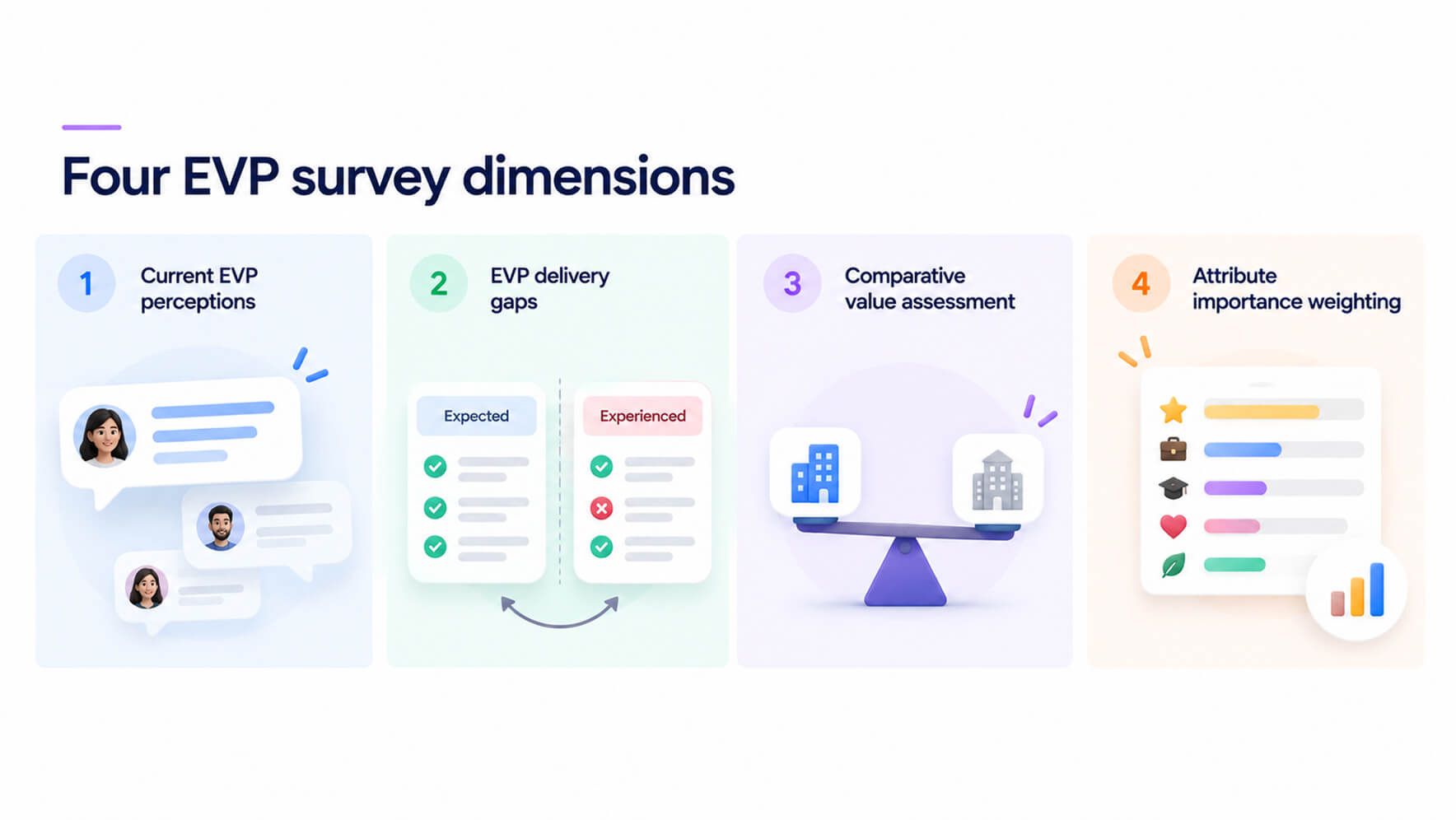
1. Current EVP perceptions
What attributes do employees genuinely value about working here, without prompting? Before you can build a credible EVP, you need to know which elements employees would actually name unprompted if someone asked them why they stay. These are your EVP strengths and the foundation of any authentic positioning.
Here are some of the questions you can ask for this:
- If a former colleague asked what makes working here different, what would you say?
- What aspects of working here do you value most?
- What would you miss most if you left?
2. EVP delivery gaps
Where is the gap between what employees expected when they joined and what they have actually experienced? This is the most commercially important dimension of an EVP survey because it reveals the specific places where the employment promise is breaking down, which is where retention risk concentrates.
You can ask questions like:
- Looking back on what you expected when you joined, what has met or exceeded your expectations?
- What has fallen short?
- Where do you feel the organization has not followed through on what it said it would provide?
3. Comparative value assessment
How does this job compare with what employees think they could get somewhere else? Employees are always comparing their options, even when companies don’t think of an EVP as something they compete on. Someone who wants better career opportunities may start looking elsewhere if they believe another company can help them progress faster, even if they seem happy in their current role.
Some of the questions you can ask related to this are:
- If you were offered a similar job somewhere else, what would make you stay?
- What might convince you to leave?
- What would another company need to offer for you to seriously consider it?
4. Attribute importance weighting
What matters most in an EVP can change from one employee group to another. Someone early in their career might care more about pay and growth. Parents may value flexibility more. Senior employees may care more about the company’s purpose and values. The important thing is to understand which parts matter most to each group when shaping your EVP.
Asking the following questions will help you figure this out:
- Rank the following aspects of working here in order of importance to you.
- How important is each of the following factors in your decision to stay with this organization?
How to measure employee value proposition effectiveness over time
An employee value proposition survey is not a one-time diagnostic. Measuring EVP effectiveness requires building it into a recurring program that tracks EVP perception over time and connects survey data to business outcomes.
Here are the different elements of a recurring employee value proposition measurement program:
- Baseline measurement
Start with a survey to see how employees view the EVP right now. You’ll be able to see what’s working, where things are falling short, and what different employee groups care about most. The results give you something to compare against later.
- Post-change measurement
Every significant change to the EVP (whether it is a compensation adjustment, a new flexibility policy, a leadership change, or an investment in development programs) should be followed by a measurement wave to assess whether employees are noticing and experiencing the change. This is how organizations know whether their EVP investments are working.
- Annual EVP tracking
An EVP survey run every year with the same core questions helps you see how employee perceptions are changing. Over time, you can compare those results with things like turnover and engagement to see whether EVP improvements are having an effect. It gives you something concrete to look at when deciding what to change next.
- Segment analysis
It is also important to look at EVP results by different employee groups. Break the results down by tenure, function, level, and demographic group to see where the differences are. Your EVP could be working well for senior leaders but not for people early in their careers. The same thing can happen across departments. An overall score can easily hide these differences.
From EVP survey data to EVP strategy
An employee value proposition strategy built on survey data looks very different from one built on leadership assumptions.
When survey data shows that flexible work is consistently the most valued attribute across nearly every employee segment, a strategy that leads with office culture and collaboration space investment will underperform. When survey data shows that employees trust their immediate manager but do not feel leadership communicates honestly about the organization’s direction, a strategy focused on compensation improvements will not move the needle on retention.

The survey data translates into EVP strategy decisions in three areas. Those are:
- What to amplify: The attributes that employees genuinely value and that the organization reliably delivers are the authentic strengths of the EVP. These should be at the center of employer branding, recruitment messaging, and internal communication. They are credible because they are real.
- What to fix: The gaps between what was promised and what is being delivered are the priority investments. These are the places where the organization is losing employee trust and retention potential. Fixing them has more impact than adding new benefits to an EVP that is already failing to deliver on its core commitments.
- What to stop saying: If an attribute appears prominently in the organization’s EVP communications but is consistently rated poorly in employee surveys, continuing to lead with it damages credibility. Employees who know the claim does not match reality will discount everything else the organization says about the employment experience.
Running EVP surveys with Zoho Survey
EVP surveys have a few requirements that are easy to overlook. Employees may need to see different questions depending on how long they have been with the company, their level, or the team they are part of. The survey also needs to feel genuinely anonymous if you want people to be honest about management, leadership, and company culture. HR teams should also be able to break down the results by the employee groups they care about.
Zoho Survey has anonymity settings that can help employees give more honest feedback on sensitive topics, such as management quality, trust in leadership, and whether they are thinking about leaving. Its branching and piping features let you show different questions to different employee groups so that people aren’t answering questions that don’t apply to them. You can then use cross-tabulation reports to compare results across departments, tenure, and seniority. This is often where the differences between employee groups become clear.
For companies using EVP surveys as part of a larger employee listening program, Zoho Survey can connect with Zoho People and third-party HRIS platforms. This lets you match survey responses with existing employee records for segmentation without doing the matching manually.