
Your team is ready to launch the product. The design is complete, pricing is finalized, and the marketing campaign is nearly set. The only question remaining is whether the product will be valuable to customers.
A survey can measure interest from potential buyers, but it may not reveal what specifically interests them. Is it the design, the price, a particular feature, or the problem the product solves? A focus group can help answer these questions by exploring the reasons behind customer preferences through discussion.
While both methods support market research, they serve different purposes. Surveys measure opinions and reveal what the market thinks, while focus groups explore why people hold those views.
Understanding these differences helps businesses choose the right research method and make informed decisions based on customer feedback.
What is a focus group?
A focus group is a qualitative research method in which a small group of people comes together to discuss a particular topic, product, service, or experience under the guidance of a moderator.
A focus group differs from a one-on-one interview. It involves several people discussing the same topic together. Participants can respond to each other, debate, share experiences, and offer perspectives the researcher may not have considered.
For example, a company developing a new grocery label might ask shoppers to review the proposed design. Some focus on nutrition information, while others appreciate the packaging but struggle to identify the product. This feedback helps identify what works and what needs improvement.
Focus groups typically include 6 to 8 participants, though the ideal size depends on research objectives. A moderator leads the discussion and ensures everyone has an opportunity to contribute.
Qualitative vs. quantitative research
Focus groups and surveys differ in the kind of information they generally gather.
Focus groups are essentially qualitative. They explore opinions, experiences, motivations, and reactions through open discussion.
Surveys are a common quantitative research method. They collect responses from large groups, allowing you to identify patterns and measure preferences. Including open-ended questions can also provide qualitative feedback. Zoho Survey's guide to quantitative vs. qualitative research covers the topic in more depth.
For example, a survey might show that 65% of respondents prefer a particular product design. A focus group can then explore what they liked about the design and why they chose it.
In summary, focus groups help you understand why people hold their views, while surveys measure how common those views are.
Focus group vs. survey: key differences
| Focus groups | Surveys | |
|---|---|---|
| Main purpose | Explore opinions and motivations | Measure preferences and patterns |
| Research type | Primarily qualitative | Primarily quantitative |
| Participants | Small, selected group | Usually a larger sample |
| Data collection | Guided discussion | Structured questions and responses |
| Insights | Detailed explanations | Measurable feedback |
| Best suited for | Exploring ideas and behaviors | Measuring awareness and satisfaction |
Neither approach is inherently superior. The choice depends on your research question, target audience, and the type of insight you need.
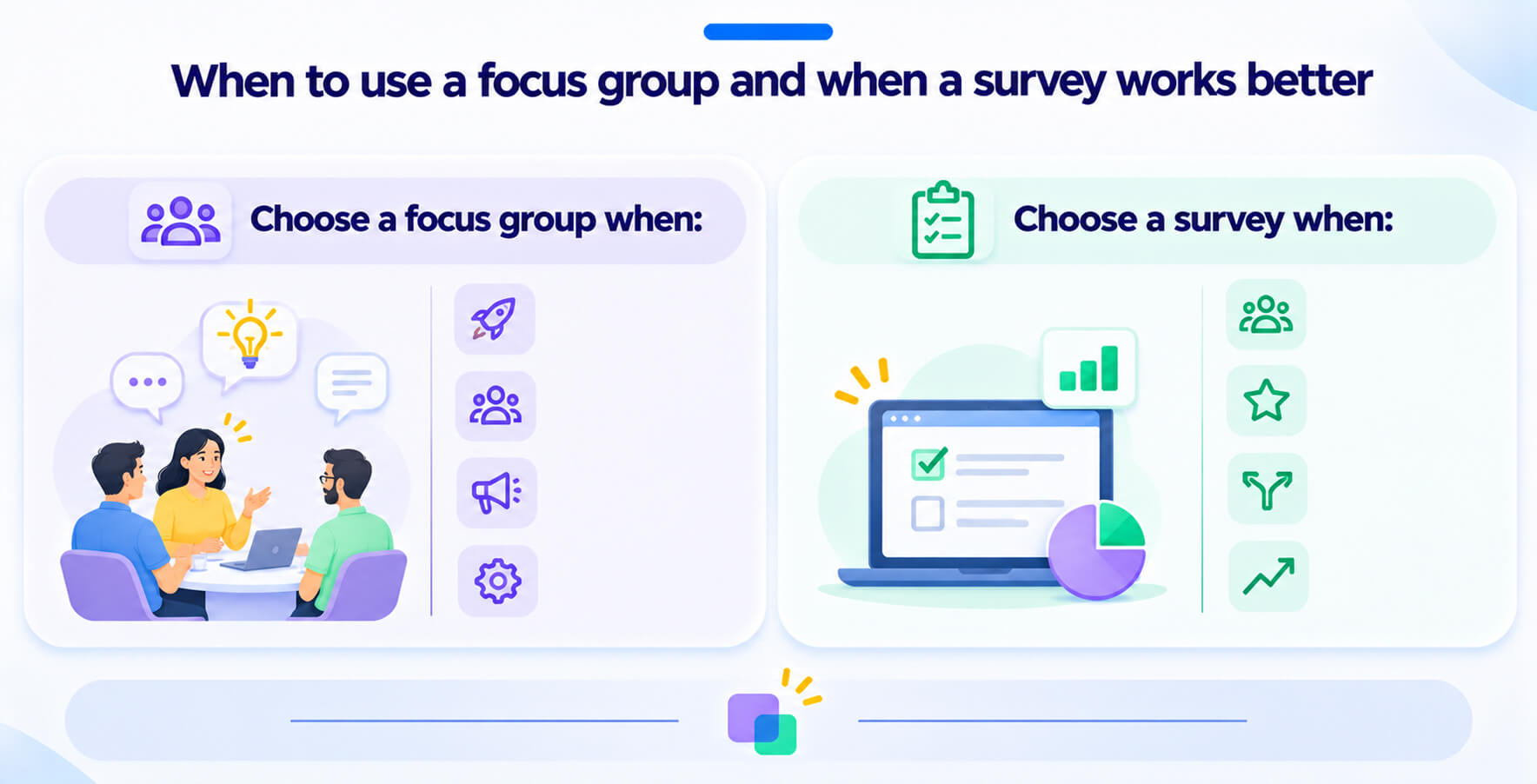
When to use a focus group and when a survey works better
Suppose a company has developed two versions of its mobile app onboarding process and wants to understand why users drop off during registration.
A focus group can probe first impressions, confusing instructions, and unnecessary steps. A follow-up survey can then measure how frequently users encounter these issues.
Choose a focus group when:
- An idea needs exploring: you want reactions to a new product, concept, or campaign before launch.
- Customer motivation matters: you need to know why people prefer one thing over another and what concerns they have.
- Messaging needs testing: you want to know how people interpret an ad, a headline, or a brand message.
- The problem is unfamiliar: you want participants to raise issues your team may not have thought of.
Choose a survey when:
- Feedback is needed at scale: you need input from a much larger audience.
- Satisfaction must be measured: you want to assess customer experience or product satisfaction.
- Options need comparing: you want to measure preferences among products, features, or designs.
- Changes need tracking: you plan to repeat the research and compare results over time.
Businesses can also combine both approaches. A focus group can help identify key questions, and a survey can determine whether those findings apply to a broader audience.
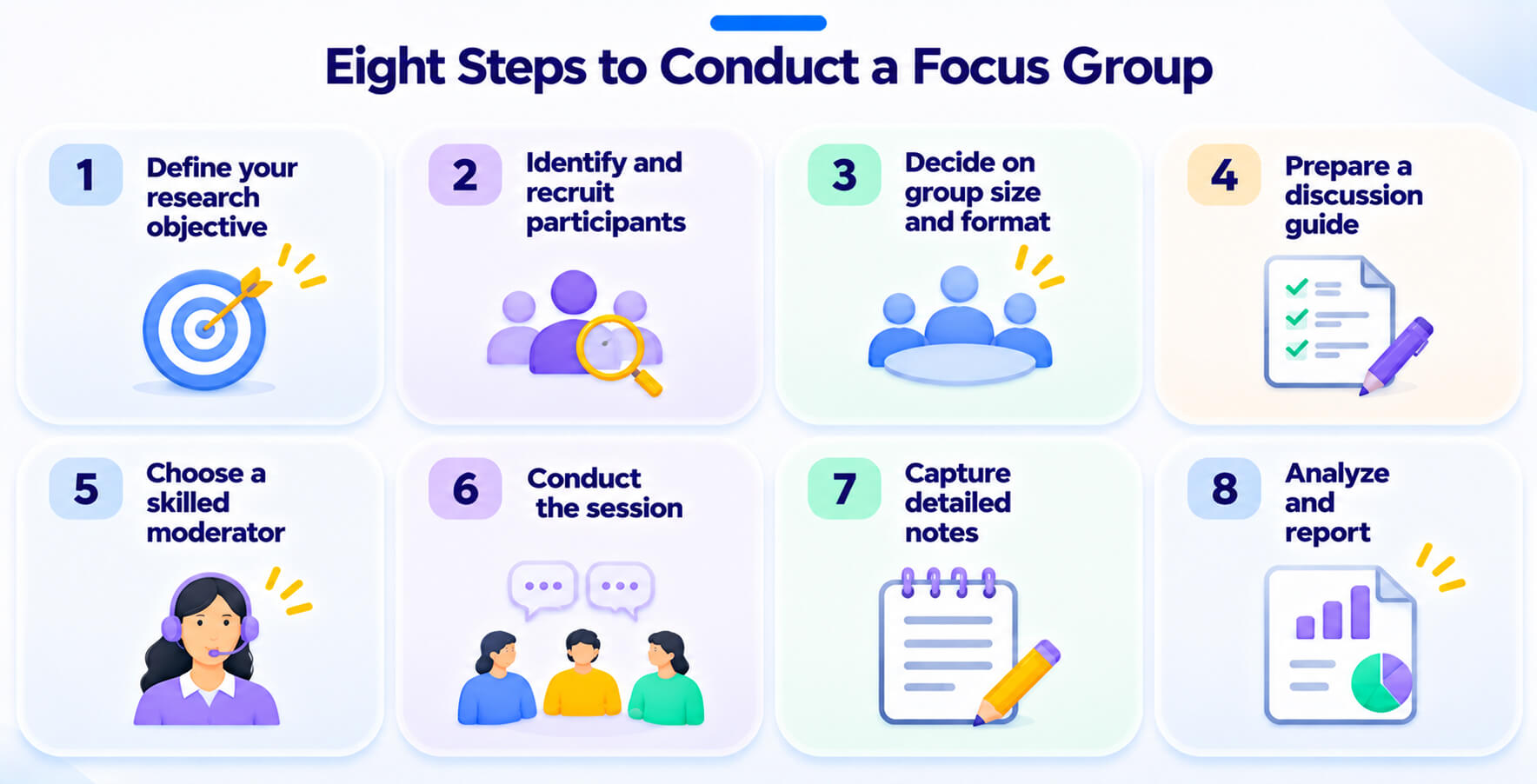
How to conduct a focus group: 8 practical steps
A productive focus group requires thorough planning, a skilled moderator, and a clear analysis approach.
1. Define your research objective
Decide what you want to learn. Are you testing a product concept, understanding customer dissatisfaction, or evaluating reactions to a campaign? A clear objective keeps the discussion focused.
2. Identify and recruit participants
Select participants whose experiences or characteristics align with your research goals. For example, if testing a fitness app, recruit users of fitness apps or those in your target market. Use screening questions to confirm suitability. Zoho Survey's guide to pre-screening questions can help.
3. Decide on group size and format
Six to eight participants provide a balanced range of views and keep the discussion manageable. Choose in-person or online sessions based on the topic, accessibility, and participant availability.
4. Prepare a discussion guide
Organize open-ended questions logically, starting broad and moving to specifics. Avoid leading questions. For example, instead of "Don't you think this design is easier to use?" ask "How would you describe your experience using this design?"
5. Choose a skilled moderator
The moderator should encourage quieter participants, manage dominant voices, ask relevant follow-up questions, and remain neutral. Their role is to facilitate discussion without influencing participants' views.
6. Conduct the session
Explain the purpose, ground rules, and how the information will be used. Focus groups typically last 60 to 90 minutes. If the discussion will be recorded, obtain participants' consent first.
7. Capture detailed notes
Assign a note-taker or use recordings and transcripts to capture recurring views, points of contention, and unexpected suggestions. Detailed notes help preserve the context of participants' comments.
8. Analyze and report
Group responses by theme and connect them to your research objective. Identify recurring issues, differing opinions, and areas needing further investigation. Clearly distinguish participant observations from your own interpretations in the final report.
Focus group questions
Open-ended questions encourage participants to explain their experiences rather than give yes-or-no answers. A good discussion moves through four types of questions:
- Opening questions: Help participants settle in. “Tell us a little about how you currently shop for groceries.”
- Introductory questions: Introduce the topic. “What comes to mind when you think about meal-planning apps?”
- Key questions: Address your research objective directly. “What would make you choose this product over the one you use now?” or “What, if anything, would stop you from buying it?”
- Closing questions: Wrap up and capture anything missed. “Of everything we discussed, what matters most to you?” or “Is there anything we haven’t covered that you would like to add?”
Follow-up prompts such as “Can you tell me more?” and “What influenced that view?” help moderators probe deeper without leading participants to a specific conclusion. Keep the guide to around 10–12 questions to ensure there is enough time for meaningful discussion within a 60- to 90-minute session.
How to analyze focus group data
Review your notes or transcripts and identify key themes. Group similar responses such as usability issues, pricing concerns, or product expectations. For example, if several participants mention uncertainty about whether a transaction went through, and others note that the confirmation message is hard to see, this indicates a usability issue.
Pay attention to dissenting views and unique observations, but do not assume a single comment represents the entire customer base. Link your findings back to your research questions:
- What were the key themes and observations?
- What were the limitations?
- What next steps do you recommend?
If you need broader validation, consider a survey or additional research.
Also read: Statistical analysis of survey data: The right approach and best tool
Advantages and disadvantages of focus groups
Focus groups offer detailed feedback, as participants share their own views and experiences. Group interaction allows participants to build on each other's ideas and introduce new perspectives. Flexible discussion enables moderators to ask follow-up questions and explore interesting responses. At early stages, focus groups help identify product issues and customer expectations before launch.
However, be mindful of their limitations:
- Limited representation: A small group may not represent the wider target audience.
- Group influence: People may go along with the majority view or be reluctant to dissent.
- Moderator bias: How questions are phrased can affect the answers.
- Time and resources: Recruitment, moderation, and analysis all take time and resources.
Focus group vs. interview: what is the difference?
Both are qualitative methods, but they gather insights differently.
A focus group involves several people discussing a topic. It helps identify shared opinions and differing viewpoints.
An interview is typically one-on-one. It allows deeper exploration, especially when the subject is sensitive or when you need individual perspectives. If the topic is something people might not want to discuss in a group, individual interviews are usually the better approach.
How Zoho Survey supports survey research
Focus groups require human moderation and qualitative analysis. Surveys work well for businesses that need structured feedback from a larger audience.
Zoho Survey offers features that support different stages of survey research:
- Question creation: Use various question types to gather both structured responses and open-ended feedback.
- Respondent screening: Use disqualification logic to identify respondents who meet certain research criteria.
- Survey flow: Skip logic directs respondents to relevant questions or pages based on their answers. Piping uses information from earlier responses to tailor later questions.
- Analysis: Sentiment analysis can gauge the tone of long-form responses. Word clouds show the most commonly used words in long responses.
- AI survey creation: Zoho Survey can use AI to generate a survey from a written description. The team can then review, edit, and refine the questions before publishing.
These capabilities support survey creation and analysis but do not replace a focus group moderator or the interpretation needed to understand focus group discussions.
The bottom line
Focus groups and surveys are distinct market research methods. Focus groups explore why people think the way they do, while surveys measure preferences and identify emerging patterns.
A company launching a new product might begin with a focus group to gather initial reactions and refine the concept, then use a survey to gauge interest from the target market.
The two approaches are not mutually exclusive. Used together, they help businesses move from understanding customers to making better decisions.
Looking to understand your target audience better at scale? Build your survey with Zoho Survey.