
When Eneco, a Dutch energy provider, wanted to attract customers for home electric vehicle chargers, it faced a familiar marketing problem. Potential buyers had plenty of information available, but getting a clear answer about the cost wasn't easy. The company created an interactive calculator that estimated charger costs and collected information about buyers' preferences.
Promoted through Facebook Ads and Google Display, the calculator generated nearly 1,000 leads in six weeks, against an initial target of about 200. Respondents received personalized cost estimates by email, while Eneco collected information its sales team could use to qualify prospects.
The useful part of this example isn't simply the number of leads. Eneco gave potential customers a reason to respond and collected information that made subsequent conversations more relevant. That's what a well-designed lead generation survey should accomplish. It connects what prospects want to know with what a business needs to know before approaching them.
What is a lead generation survey?
A lead generation survey is a questionnaire that helps businesses identify potential customers, understand their needs, and assess whether their products or services are a suitable fit. A conventional lead form might ask for a name, email address, company, and phone number. These details establish contact, but they don't necessarily explain why someone is interested or whether they are ready to buy.
A lead generation survey adds questions about the prospect's challenges, preferences, existing solutions, budget, and purchasing plans. A business can use these answers to group leads, personalize follow-ups, and identify opportunities worth prioritizing.
How businesses can use surveys to generate better leads
Survey responses can support several parts of the lead generation process. The best application depends on what the business sells, who makes the purchasing decision, and where prospects are in their buying journey.
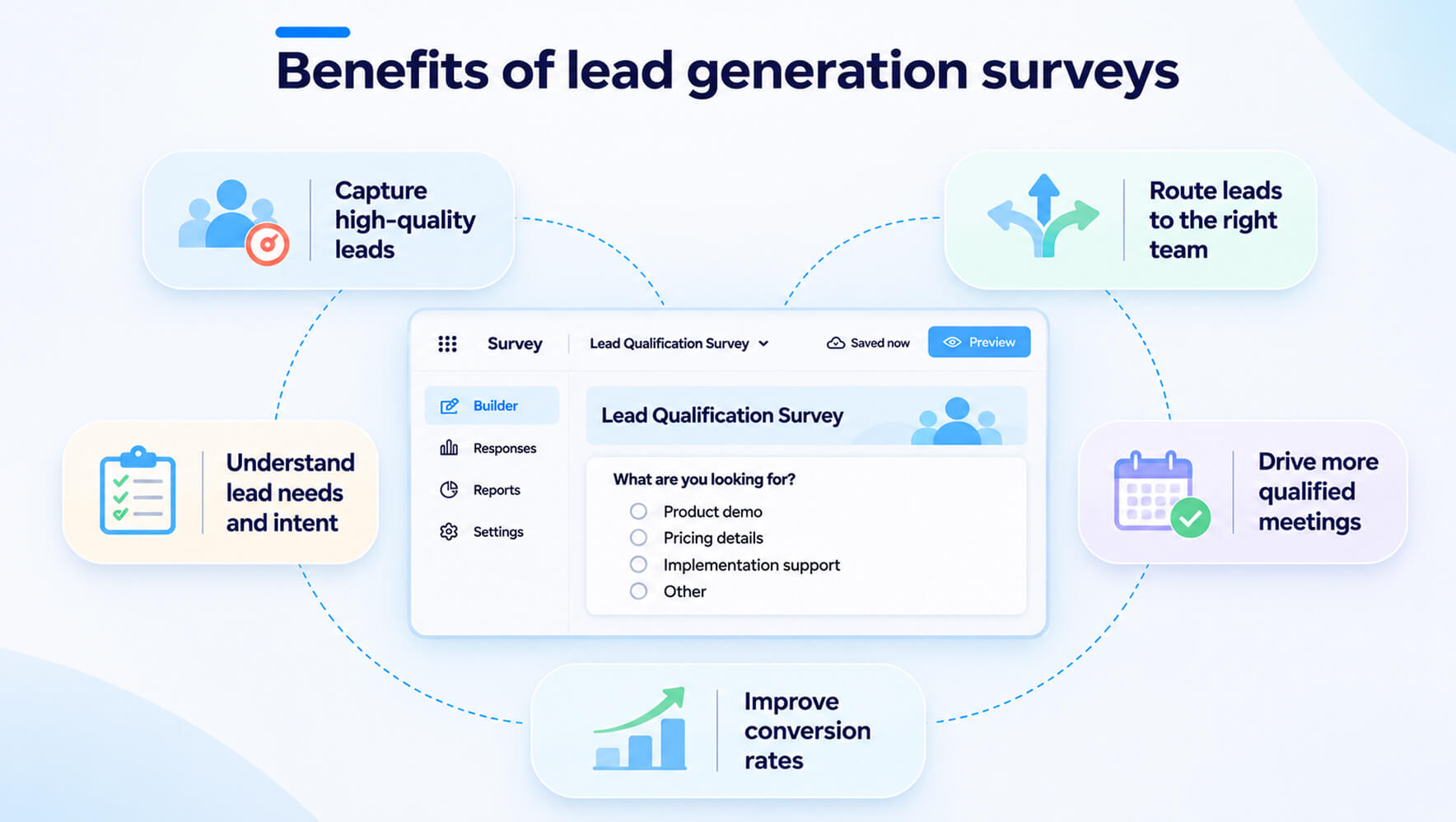
Understand the problems potential customers want to solve
Product features alone don't explain why someone would purchase a solution. Prospects may be looking to reduce costs, eliminate manual work, improve service, or address a problem that has become increasingly difficult to manage.
Questions about these challenges help businesses understand what brings potential customers to their website or campaign. Suppose an IT services company wants to attract small businesses. It could ask visitors about:
- Their biggest technology concerns
- Whether they have in-house IT support
- What prompted them to seek external help
The responses could reveal distinct opportunities. A company experiencing frequent downtime might need infrastructure support, while another may be preparing to migrate its systems to the cloud. The service provider can use these differences to develop more relevant landing pages, case studies, and follow-up messages.
Identify qualified prospects
A large list of leads isn't necessarily useful from a sales perspective. Someone who downloads a resource for research may have little intention of purchasing, while a small business manager actively looking for a solution could represent a more immediate opportunity.
This distinction matters to marketing teams. A Marketing Week survey of 600 B2B marketers found that 40% felt pressure to deliver marketing-qualified leads regardless of quality. The result highlights a practical challenge: generating more leads can become a distraction when the real objective is to identify prospects who fit the business.
A lead generation survey can ask about company size, current needs, budget range, decision-making responsibility, and purchasing timeline. These answers help sales and marketing teams assess fit.
The results should inform qualification (not replace it). Even a prospect who indicates a suitable budget and an immediate need may still require internal approval before moving ahead.
Segment prospects for relevant follow-ups
The same product can appeal to different audiences for different reasons. A survey helps businesses identify these differences and adapt their messaging.
A website design agency, for instance, could use survey responses to distinguish between businesses launching their first website, companies redesigning an outdated site, and established brands seeking better conversion rates.
Each group has a different problem to solve. A new business might need help understanding the design process, while an established brand may want to discuss analytics, user experience, and conversion optimization. Instead of sending all three groups the same email sequence, the agency can share content that addresses each group's priorities.
Understand when prospects intend to buy
Interest doesn't automatically mean purchase readiness. Someone comparing solutions for an upcoming project needs a different follow-up from someone considering a purchase next year. Ask respondents whether they are actively evaluating providers, planning to purchase within a specific period, or gathering information for a future decision.
This matters particularly in B2B sales. 6sense's 2025 B2B Buyer Experience Report based on research involving nearly 4,000 B2B buyers found that 95% of winning vendors were already on the buyers' initial shortlist. The report also found that roughly four in five deals went to the vendor that buyers favored before their first sales conversation.
For businesses, this reinforces the importance of understanding buyers before they request a sales call. A survey can reveal what matters to prospects during their research, helping marketing teams provide relevant information before they settle on a competitor.
Lead generation questions to ask potential customers
Effective lead generation questions collect information that helps a business understand prospects without making the survey unnecessarily demanding. Choose questions based on your qualification criteria and the decisions your team needs to make.
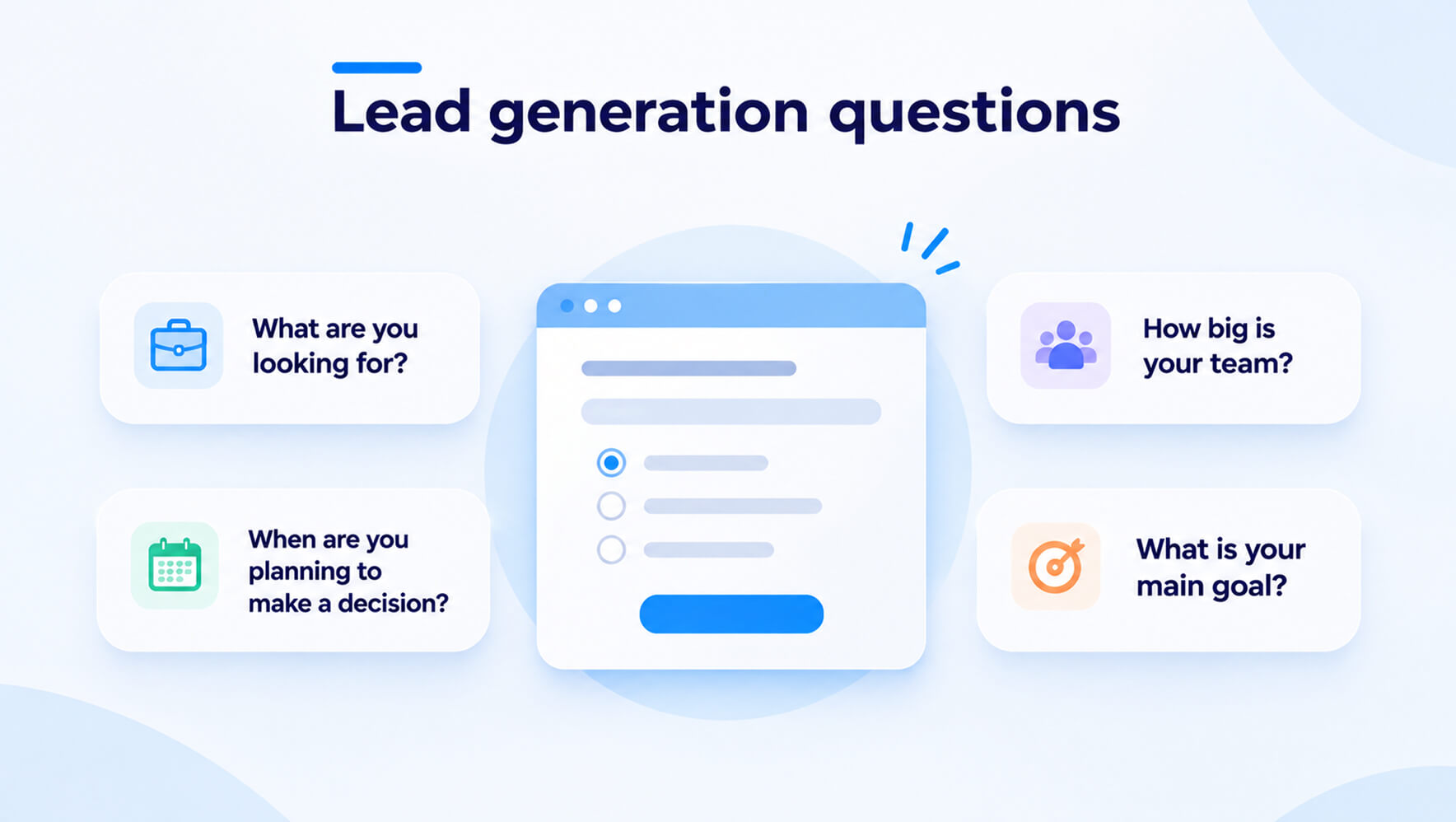
Questions about customer needs and challenges
Use these questions to understand why a prospect is looking for a solution.
- What is the biggest challenge you're currently facing with [relevant task or process]?
- How do you currently address this challenge?
- What would you most like to improve about your current approach?
- What prompted you to look for a new solution?
- Which outcome would provide the greatest value to you?
Questions about preferences and requirements
These questions reveal what prospects value when evaluating products or services.
- Which features or capabilities are most important to you?
- What factors influence your choice of a provider?
- What tools or solutions are you currently using?
- What is your preferred budget range?
- Are there any essential requirements a new solution must meet?
Questions about buying intent and qualification
Use these questions to understand whether a prospect is ready for a sales conversation.
- When do you expect to purchase or implement a solution?
- Are you currently comparing products or providers?
- What could prevent you from moving forward with a purchase?
- Who is involved in making the final decision?
- Would you like a product demonstration, consultation, or follow-up from our team?
Lead generation survey best practices
The quality of a lead generation survey depends on what it asks, how it reaches prospects, and what the business does with the responses. These practices help maintain that focus.
Give prospects a reason to participate
A survey should offer a clear benefit to the respondent. That might be a personalized recommendation, a cost estimate, a relevant checklist, or an insight that helps them make a decision.
Choose an incentive or outcome that relates directly to your offering. A useful assessment will generally attract more relevant interest than a generic giveaway, although results depend on the audience and execution.
Keep the questions focused
Every question should serve a purpose. Remove fields that don't help you understand, qualify, or follow up with a prospect. Use clear language, avoid asking for information you already have, and don't combine multiple questions into one. For example, asking respondents to rate both price and usability in a single question makes their answers difficult to interpret.
The Pew Research Center's guidance on survey question design explains how wording and question order can influence responses. Neutral, specific questions make it easier to interpret what respondents actually mean.
Match questions to the buying stage
A visitor reading an introductory article may not be ready to share a detailed purchasing budget. Someone requesting a product demonstration may be more willing to discuss implementation requirements and decision timelines.
Adjust your questions to the context in which the survey appears. Early-stage surveys can focus on challenges and interests, while qualification surveys for sales-ready prospects can ask about budgets, requirements, and timelines. This approach also helps avoid requesting sensitive or unnecessary details before there's a clear reason to do so.
Use conditional logic to reduce irrelevant questions
Not every respondent needs to answer the same questions. Branching logic can route people to relevant follow-ups based on their earlier responses. Conditional logic keeps the experience relevant and gives the business more contextual information without adding unnecessary questions for everyone.
Choose the right distribution channel
Share the survey where your target audience is most likely to engage. Depending on the business, that could mean email newsletters, landing pages, social media, event follow-ups, or relevant online communities.
Track the source of responses where possible. A channel that produces fewer responses may still be more valuable if those respondents match your ideal customer profile and progress to sales conversations.
How Zoho Survey can support lead generation
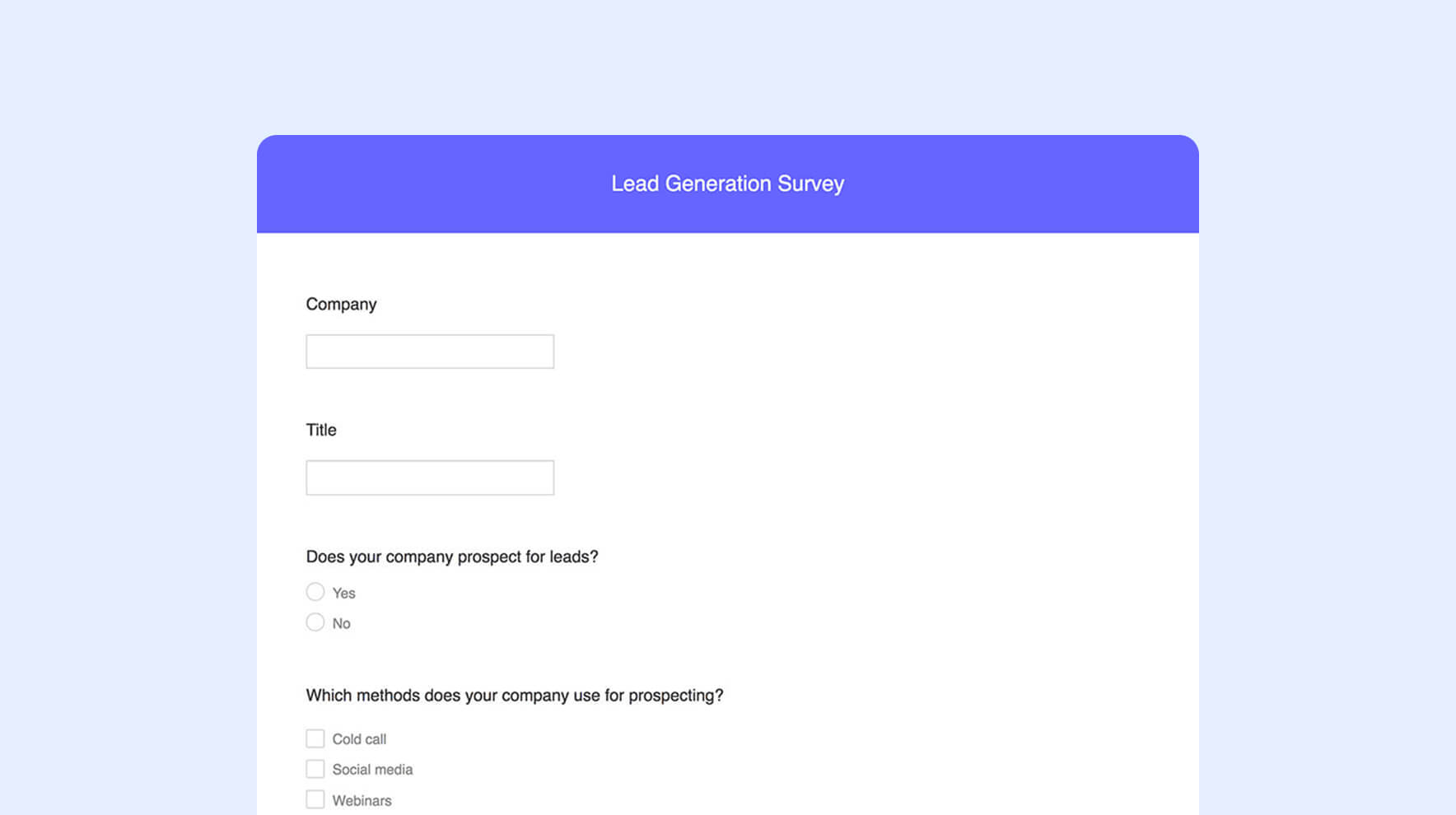
Zoho Survey lets businesses create custom questionnaires using different question types, templates, and survey logic. These capabilities can help marketing teams build lead qualification surveys, assess customer needs, and collect information for more relevant follow-ups.
Its survey features include question logic, page logic, customizable questionnaires, reports, and integrations. For instance, a SaaS company could create a survey that asks visitors about their existing software, their biggest operational challenge, and their implementation plans. Depending on their answers, respondents would see relevant follow-up questions.
The team could then analyze response patterns to understand common requirements and identify prospects for further engagement. Integrations can also help businesses connect survey activity with other applications in their workflow.
Zoho Survey offers a selection of survey templates, including a lead generation survey template, that businesses can adapt to their needs, as well as reporting options for reviewing responses. Companies can use these features to turn questionnaire data into information that informs marketing and sales decisions.
Businesses can try Zoho Survey through its 7-day, credit-card-free Enterprise trial, which provides access to the platform's Enterprise features.
Turn prospect insights into more relevant leads
Lead generation surveys work best when they connect customer needs with specific business decisions. A prospect's answers can help determine which content to share, which products to recommend, and when a sales conversation makes sense.
Start with a clear objective, ask relevant questions, and collect only the information your team needs. Then compare survey responses with actual sales outcomes to understand which signals indicate a strong opportunity. The result isn't necessarily a longer lead list. It's a better understanding of the people on that list and a more informed way to approach them.