
Most people who write surveys for a living use the terms "leading question" and "loaded question" interchangeably. And most of the time nobody notices, because both produce data that doesn’t actually reflect what respondents think. But they’re not the same problem, and knowing the difference matters because the fix for one doesn’t always fix the other.
A leading question nudges someone toward an answer. A loaded question assumes something about the respondent before they have even had a chance to answer at all.
In this article, we dive deep into the differences between these two types of questions and explore how we can avoid them in the surveys we conduct.
What are leading questions?
A leading question can make people feel like they are supposed to give a particular answer. Sometimes all it takes is one word or a small change in how the question is written. The topic stays the same, but the wording can push people toward a different response.
Pew Research Center showed how easily this can happen in an experiment. Half of the people surveyed were asked if “good” jobs were available in their community. The other half were asked if jobs were available, without the word “good.” 60% percent said jobs were available, but only 48% said “good jobs” were available. That one word created a 12-point difference. It’s a good example of how much influence the wording of a question can have.
Leading question examples
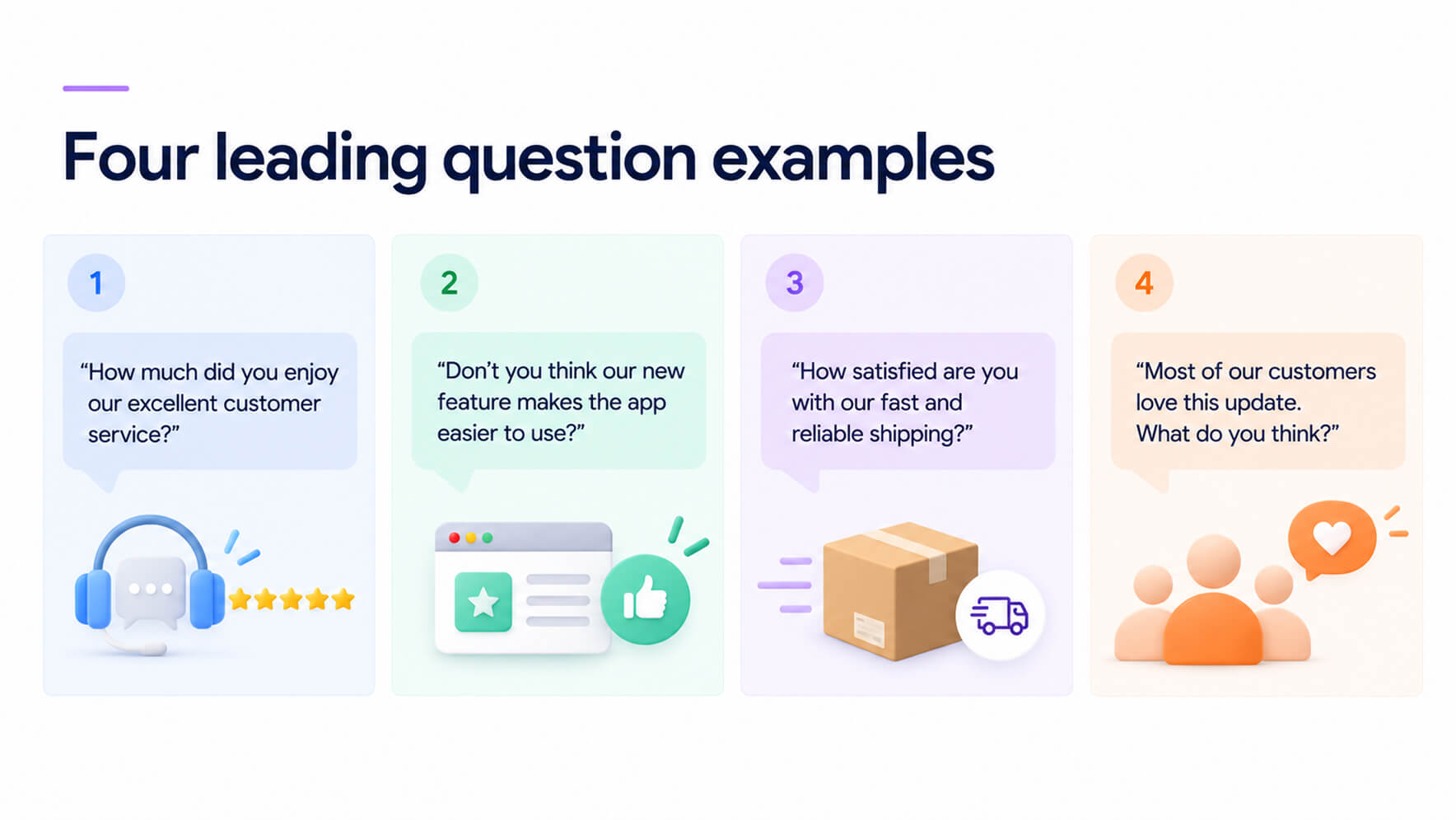
Here are a few examples of leading questions in surveys make the pattern easier to spot in your own drafts:
- “How much did you enjoy our excellent customer service?” assumes the service was excellent before asking the respondent to weigh in.
- “Don’t you think our new feature makes the app easier to use?” invites agreement through the phrasing itself, since disagreeing means contradicting the question as asked.
- “How satisfied are you with our fast and reliable shipping?” bakes two positive claims (speed and reliability) into a question that was only supposed to measure satisfaction.
- “Most of our customers love this update. What do you think?” uses social proof to pressure the respondent toward a favorable answer before they have formed one.
Each of these can usually be fixed the same way: by stripping out the adjective, the assumption, or the social pressure, and asking the plain question underneath it. For instance, a neutral phrasing like “How satisfied are you with our shipping speed?” avoids deciding the answer in advance.
What are loaded questions?
A loaded question is a little different. It puts an assumption into the question that the person has to accept before they can even answer. Take the question, “Have you stopped cheating on your taxes?” If you say yes, you’re admitting that you did it before. If you say no, it sounds like you’re still doing it. Either way, the question already assumes something about you. If that assumption isn’t true, there’s really no honest way to answer it.
This is what separates a loaded question from a leading one. A leading question nudges opinion. A loaded question smuggles in a fact, a behavior, or a status that hasn’t been established, and forces the respondent to either accept it or opt out of answering entirely.
Examples of loaded questions
A few examples of loaded questions that show up often in ordinary surveys are:
- “How often do you struggle to use our confusing checkout process?” assumes the checkout process is confusing and asks only how often that assumed struggle occurs.
- “What made you decide to stop recommending us to friends?” assumes the respondent used to recommend the brand and has now stopped, even if neither is true.
- “Which of our support agents was unhelpful during your last call?” assumes the call included an unhelpful agent, when the respondent might have had a perfectly fine experience.
- “Why do you think our competitor’s pricing is unfair?” assumes both that the respondent has an opinion on a competitor’s pricing and that they consider it unfair.
Here, removing an adjective doesn’t help when the problem is a buried assumption. The real fix is splitting the question into two:
- Confirm whether the assumption applies at all
- Ask a follow-up only to the respondents for whom it does
For example, a question like “Did you experience any issues with our checkout process?” followed by “What made it difficult?” only for people who said yes, replaces one loaded question with two honest ones.
Fixing leading and loaded questions
At first, this might seem like a small wording difference that doesn’t really matter. But it does change how you should fix the question. You can usually fix a leading question by changing the wording and making it more neutral. A loaded question is trickier because it already assumes something about the person answering. You need to address that assumption before moving on to the next question. If you only change the wording, you could end up with the same problem in slightly different words.
Pew Research Center’s own methodology guidance for writing survey questions makes a related point. Questions that bundle two ideas into one (sometimes called double-barreled questions) create a version of this same problem, where a respondent can’t answer honestly because the question is really asking two different things at once. Loaded questions are a close cousin. Both require breaking the question apart rather than just softening its tone.
How to avoid leading questions and loaded questions before you launch
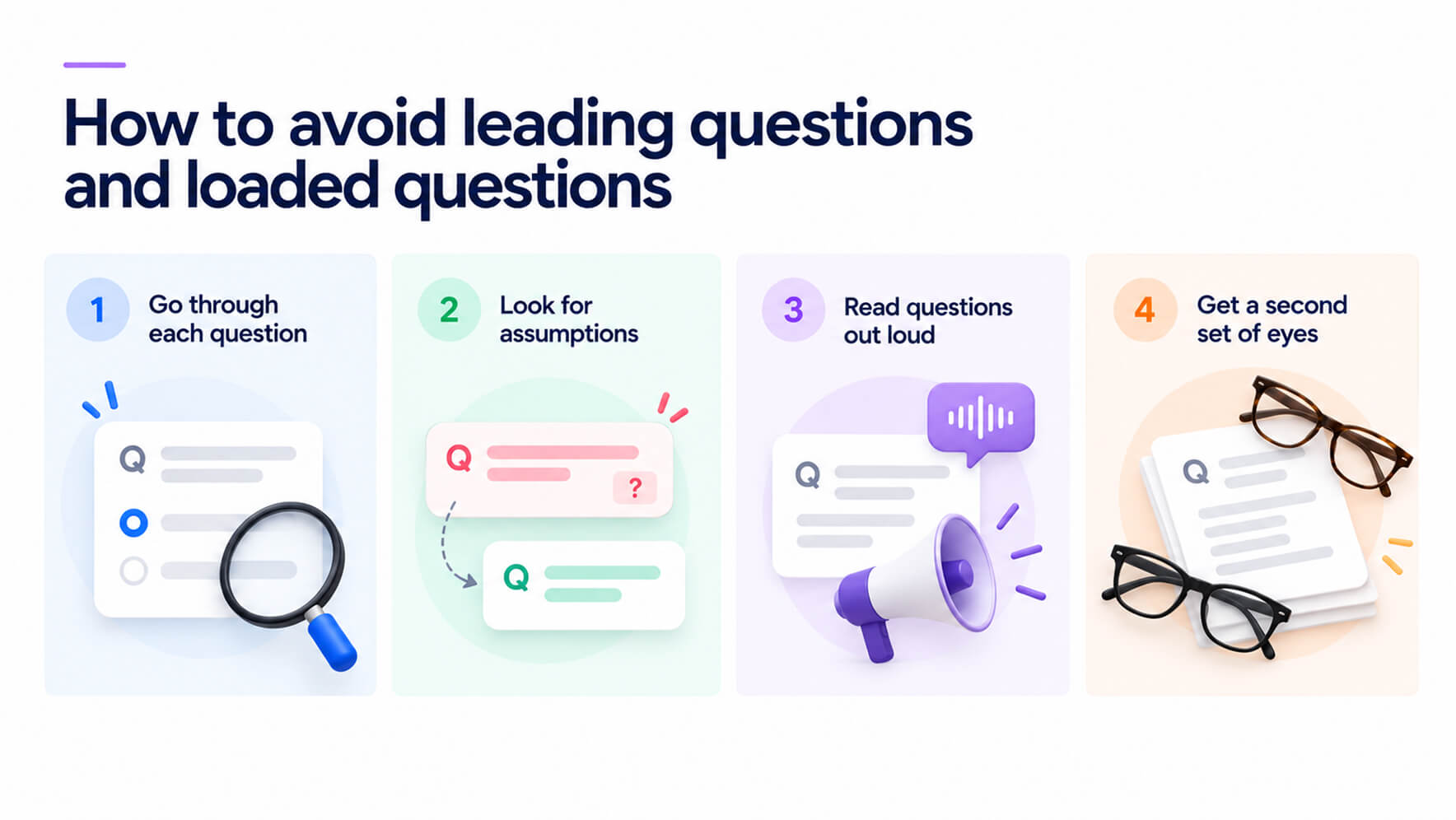
Here are a few easy ways to catch these problems before you send a survey out:
- Go through each question and ask yourself if someone who has no reason to prefer one answer could choose either option without feeling pushed in a certain direction. If one answer feels more expected than the other, or if choosing the other feels like pushing back, you are probably looking at a leading question.
- You should also look for assumptions hiding in the questions. Does the person have to agree that something is true before they can even answer? If yes, you are dealing with a loaded question. Break the assumption out into a separate question, then ask the follow-up only when it applies.
- Read questions out loud. Bias in wording is often easier to hear than to see on a screen, since the tone that tilts a question tends to be more obvious spoken aloud than skimmed silently.
- Get a second set of eyes before launch. This is often the single most effective habit, since the person who wrote a question is usually the person least likely to notice their own framing. Before that review even starts, previewing the full survey flow the way a respondent would experience it tends to surface awkward or leading phrasing that is easy to miss when reading questions in isolation.
Zoho Survey makes the review process easy for you. With its collaboration feature, you can share a review URL with colleagues so that they can test the survey, go through the whole flow, and comment on individual questions. That is much more useful than asking someone to review a static document. A teammate who wasn’t involved in writing the questions may notice leading or loaded wording that the original writer missed. Zoho Survey’s pre-built templates are another useful starting point. They cover common surveys like customer satisfaction and employee feedback and give you neutral wording to build from.
Final thoughts
These two types of questions are easy to mix up, but they need different fixes. Leading questions steer people through the way they are worded while loaded questions bring an assumption into the question itself. Once you know the problem, you can decide what to change. That could mean removing a word that pushes people toward an answer or splitting one question into two. Finding the problem before launch is a lot easier than trying to explain afterward why the survey results don’t line up with what customers actually think.