
In 1936, The Literary Digest attempted to predict the US presidential election by sending out 10 million ballots. More than 2.3 million people returned them, yet the magazine predicted a landslide victory for Republican candidate Alf Landon.
Franklin D. Roosevelt won instead, securing 523 electoral votes. The poll had reached millions of people. But its lists relied heavily on sources such as telephone directories and automobile registrations, which did not adequately represent the voting population. Who chose to respond also affected the results.
The failure illustrates a basic principle of research: collecting more responses doesn't automatically produce reliable findings. Researchers need a sampling method that fits the population they want to understand, the questions they want to answer, and the conclusions they intend to draw. The two broad categories, probability and non-probability sampling, approach participant selection differently, and each has a role in research.
What are sampling methods in research?
Sampling methods are procedures for selecting a subset of people, households, organizations, or other units from a larger population for research.
Consider a university with 20,000 students that wants to understand satisfaction with online learning. Surveying every student may be impractical. So, researchers select a smaller group and analyze its responses.
Population vs. sample: The population is the entire group a researcher wants to study. The sample is the subset selected for data collection. A sample can provide useful insights into a population when the selection method and analysis are appropriate.
The choice of sampling techniques depends on the research objective, available resources, population characteristics, and the level of statistical certainty required.
Understanding probability vs. non-probability sampling
The main difference is how researchers select participants.
What is probability sampling?
Probability sampling uses a defined random selection mechanism. Each eligible unit has a known, non-zero probability of selection under the sampling design.
Researchers can use this information to estimate the probability of sampling errors and make statistical inferences about the population, provided the design and analysis are appropriate. However, nonresponse, incomplete sampling frames, and measurement errors can still affect results.
Probability sampling methods are particularly useful for population surveys, public opinion research, and studies that need statistically defensible estimates.
What is non-probability sampling?
Non-probability sampling selects participants without a defined random mechanism that establishes each eligible unit's selection probability. Researchers may recruit participants based on availability, expertise, referrals, quotas, or willingness to participate.
This approach is often quicker and less expensive. It can work well for exploratory studies, interviews, pilot research, and hard-to-reach populations.
However, findings cannot automatically be generalized to a wider population. Researchers also cannot calculate conventional design-based margins of sampling error without the necessary probability-based selection design.
| Factor | Probability sampling | Non-probability sampling |
|---|---|---|
| Selection | Random mechanism | Non-random mechanism |
| Selection probability | Known | Generally unknown |
| Cost and time | Often higher | Often lower |
| Population estimates | Supports design-based inference | Requires additional assumptions for generalization |
| Common uses | Population surveys and prevalence estimates | Exploratory studies and qualitative research |
Neither approach guarantees accurate results. The right choice depends on what the research needs to establish.
Probability sampling methods with examples
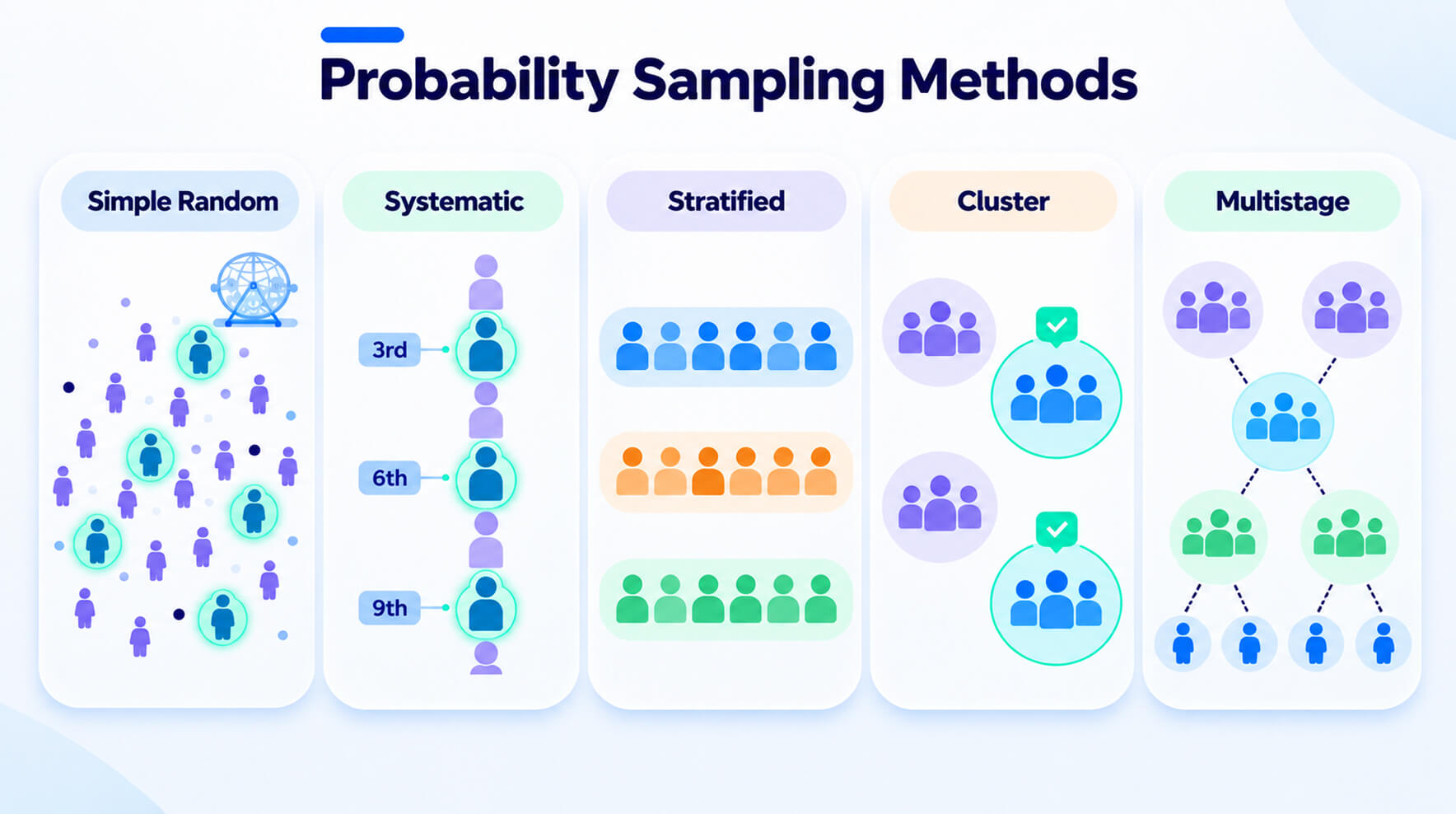
Probability sampling uses random selection to reduce selection bias and support statistical inference. The main types of sampling methods in this category are simple random, systematic, stratified, cluster, and multistage sampling.
Simple random sampling
Simple random sampling gives every unit in the defined population the same chance of selection when researchers draw a fixed-size sample without replacement.
Example: A university assigns IDs to 5,000 students and uses a random number generator to select 300 for a survey.
This method works well when researchers have a complete list of eligible participants. Its main limitation is that obtaining such a list can be difficult.
Systematic sampling
Systematic sampling selects participants at regular intervals from an ordered list after a random starting point.
Researchers calculate the sampling interval by dividing the population size by the intended sample size.
Example: A business selects 400 customers from a list of 4,000 by choosing a random starting point and then selecting every 10th customer.
Systematic sampling is straightforward to administer. But researchers should check for repeating patterns in the list that could bias selection.
Stratified sampling
Stratified sampling divides a population into relevant subgroups called strata, and randomly selects participants from each.
Example: A retailer wants feedback from three regions representing 60%, 25%, and 15% of its customer base. For a sample of 1,000, proportional stratified sampling selects 600, 250, and 150 customers, respectively.
Stratified sampling helps ensure that important subgroups are represented. Researchers can also oversample smaller groups when they need more detailed subgroup analysis, then apply appropriate weights.
Cluster sampling
Cluster sampling divides the population into natural groups such as grade levels within a school or neighborhoods in a city. Researchers randomly select clusters and then survey all eligible units within them or sample individuals inside the chosen clusters.
Example: The US Centers for Disease Control and Prevention uses cluster sampling in its Community Assessment for Public Health Emergency Response (CASPER) methodology. Its standard design selects 30 geographic clusters and seven households per cluster, targeting 210 household interviews.
Cluster sampling can reduce travel and fieldwork costs when populations are geographically dispersed. However, people in the same cluster may be similar in ways that limit the broader applicability of findings.
Multistage sampling
Multistage sampling selects participants through several stages, often combining different probability sampling methods.
Example: A national education survey randomly selects regions, then districts within those regions, schools within those districts, and students within the selected schools.
This method is useful for large populations where creating a single list of every individual would be impractical. Researchers must account for each stage's selection probabilities when analyzing the results.
Non-probability sampling methods with examples
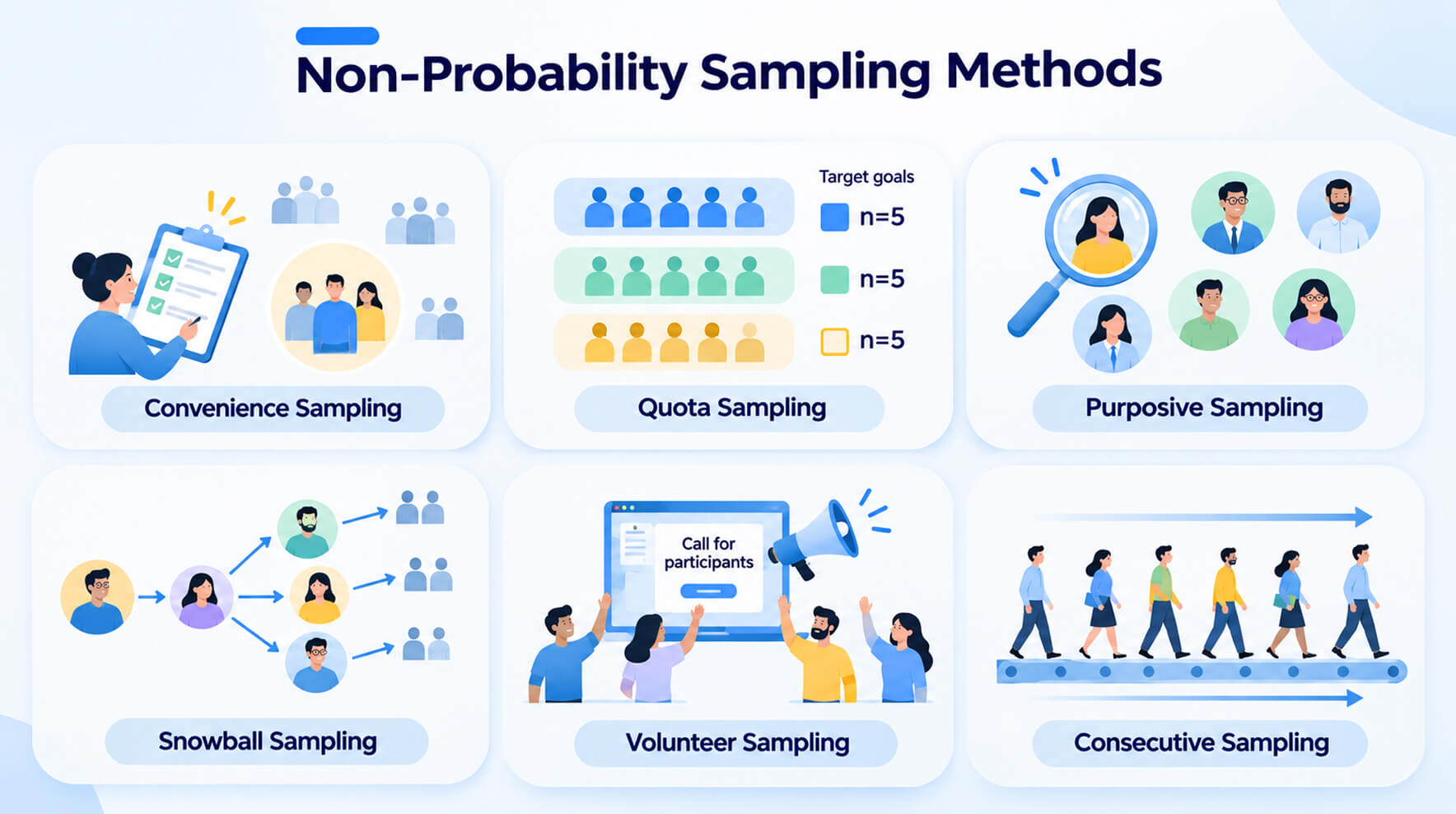
Non-probability sampling is useful when researchers need specific experiences, quick feedback, or access to groups that are difficult to identify through conventional sampling frames.
Convenience sampling
Convenience sampling recruits people who are easiest to reach.
Example: A cafe places a QR code on its counter and collects feedback from customers who choose to scan it.
The method is inexpensive and useful for early feedback. But respondents may not be representative of all customers.
Quota sampling
Quota sampling sets targets for specific groups and recruits accessible participants until each target is met.
Example: A researcher wants 500 responses, with 250 from people aged 18–34 and 250 from people aged 35 or older.
Quota sampling helps achieve a desired mix of characteristics, but matching quotas does not make the sample statistically representative. Participants within each group are not selected randomly.
Purposive sampling
Purposive sampling deliberately recruits people with experience or knowledge relevant to the research question.
Example: A researcher studying hospital AI implementation interviews administrators who have led AI projects.
This method is useful for expert interviews, qualitative studies, and research into specialized experiences. Its purpose is to gather relevant insights rather than estimate population-wide percentages.
Snowball sampling
Snowball sampling asks existing participants to refer other people who meet the study's criteria.
Example: A researcher studying a specialized group of freelance professionals interviews a few participants and asks them to refer other eligible workers.
It can help researchers reach hidden or difficult-to-access populations. However, participants may refer people from similar networks, leaving other perspectives underrepresented.
Volunteer sampling
Volunteer sampling recruits people who choose to participate after seeing an open invitation.
Example: A news website publishes a poll asking readers whether public transport should become free.
People with strong opinions may be more likely to respond. So, the results describe the participants rather than necessarily reflecting the wider public.
Consecutive sampling
Consecutive sampling recruits every eligible participant who becomes available during a defined period until the sample size is reached or the study period ends.
Example: A clinic invites every eligible patient attending over six weeks to participate in a satisfaction study.
It provides a more systematic recruitment process than simply approaching whoever is easiest to reach. However, the sample may not represent patients who attend other clinics or visit at different times.
How to choose the right sampling method
Start with the question your research needs to answer.
- Need population estimates? Probability sampling is generally preferable when you need to estimate proportions, compare groups, or make statistical inferences.
- Studying specialized experiences? Purposive or snowball sampling may help recruit participants with relevant knowledge.
- Working with a large geographic population? Cluster or multistage sampling can make fieldwork more practical.
- Need quick initial feedback? Convenience or volunteer sampling may suit exploratory research, provided limitations are acknowledged.
- Need representation across specific groups? Stratified sampling can ensure subgroups are included through random selection. Quota sampling can fill subgroup targets without random selection.
Sample size also matters, but enlarging the sample cannot compensate for a flawed selection process. For a large population, a simple random sample of roughly 385 completed responses can estimate a proportion with a 95% confidence level and a margin of error of approximately five percentage points under common assumptions. That calculation does not automatically apply to non-probability samples or more complex designs.
Common sampling mistakes to avoid
Researchers can undermine their findings even when they select a familiar method.
Confusing quotas with random selection: Having the right number of people in each group doesn't mean individuals were randomly chosen.
Ignoring nonresponse: People who don't respond may differ from those who do, affecting the findings.
Using sample size as proof of quality: A large sample can still be biased if important groups are excluded.
Overgeneralizing qualitative findings: Expert interviews can reveal useful themes. But they don't automatically show how common those experiences are across a population.
Failing to document recruitment: Explain who was eligible, how participants were selected, and what limitations remain.
Using Zoho Survey to support sampling
Zoho Survey helps researchers build questionnaires, distribute surveys, and analyze responses. Researchers should determine their sampling method first, then use survey tools to support data collection.
For studies that require participants beyond an existing contact list, Zoho Survey's Buy Responses feature provides access to research panels segmented by demographic, economic, and geographic characteristics. Researchers should verify the panel's recruitment and selection method before treating responses as a probability sample.
Response reports can also help teams monitor participation and check whether subgroup targets are being met. Zoho Survey offers a 7-day Enterprise trial without a credit card to explore its survey creation, distribution, and reporting features. Get started today!
The bottom line
Sampling methods determine who participates in research and what conclusions the data can support. Probability sampling is generally better suited to population estimates and formal statistical inference, while non-probability sampling can be practical for exploratory studies, specialist interviews, and hard-to-reach groups.
Choose the method based on the research objective, population, resources, and level of certainty required. A smaller, well-designed sample can be more informative than a much larger sample that fails to include the people the research needs to represent.