
Seasonal demand can change without much warning. Something that sold out last holiday season might barely move this year because customers have changed their minds. The same goes for promotions. A summer offer that worked in one market might do poorly in another. And by the time the sales numbers make the problem obvious, the season may already be over.
The core problem with forecasting seasonal demand from historical data alone is that it is always looking backward. It tells you what customers did. It says almost nothing about what they are planning to do next, especially when consumer preferences, economic conditions, or competitive alternatives have changed since the last comparable period.
The consumer survey method helps fill that gap. By asking customers what they plan to buy in the coming season, businesses can get an early idea of where demand might be headed. They can then compare those responses with past sales to make their seasonal forecasts more accurate.
What is seasonal demand?
Seasonal demand refers to predictable fluctuations in the demand for a product or service that recur at regular intervals, typically tied to the time of year, cultural events, holidays, or climate patterns. It is a natural feature of most consumer markets, and misreading it in either direction has real costs.
There are problems on both sides of seasonal forecasting. Expect too much demand and you could be left with excess inventory, markdowns, and lower margins. Expect too little and you may run out of products, lose sales, and leave customers disappointed. A bad experience can stick with them even after the season ends.

You can see seasonal demand in almost every industry such as:
- Retail: Apparel sales often rise during back-to-school, Black Friday, and the holiday shopping season.
- Food and beverage: Summer brings higher demand for barbecue products, sunscreen, and cold drinks. In winter, people tend to buy more hot drinks, comfort foods, and baking ingredients.
- Travel and hospitality: Hotels and airlines tend to see a jump in bookings during school breaks, long weekends, and summer vacations.
- Consumer electronics: New phone, laptop, and other device launches can create a rush of demand, especially around the holidays. Retailers and distributors often need to plan for this months ahead.
The same seasonal patterns come around each year, but the numbers are rarely the same. Consumer spending, competitor activity, promotions, and shopping habits can all change demand. So, while last year’s sales are useful, they cannot tell you everything about what this year will look like.
Why the consumer survey method of demand forecasting matters for seasonal planning
The survey method of demand forecasting starts by asking customers what they are likely to buy for a particular product, category, or season. Those responses can then be used to estimate the expected demand.
Consumer survey data can provide a useful forward-looking signal. But stated intentions should not be treated as a direct forecast of actual purchases. A benchmark study of 2,172 shoppers found that only 58.1% of planned items were purchased, and just 11.1% of shoppers completed all the purchases they had planned. This is why survey-based demand estimates work best when combined with historical sales data and adjusted for the gap between stated intentions and actual behavior.
You still need historical sales data and statistical models, but a consumer survey can add information they do not have. It shows what customers plan to buy at the time you make the forecast. Running a survey eight to twelve weeks before a seasonal peak can also reveal changes in buying plans, product preferences, and price sensitivity before they show up in your sales data.
How the consumer survey method works
A consumer survey designed for seasonal demand forecasting is not the same as a satisfaction survey or a brand tracker. Its objective is to measure where a defined consumer segment sits on the purchase-intention spectrum for a given product or category within a specific upcoming time window.
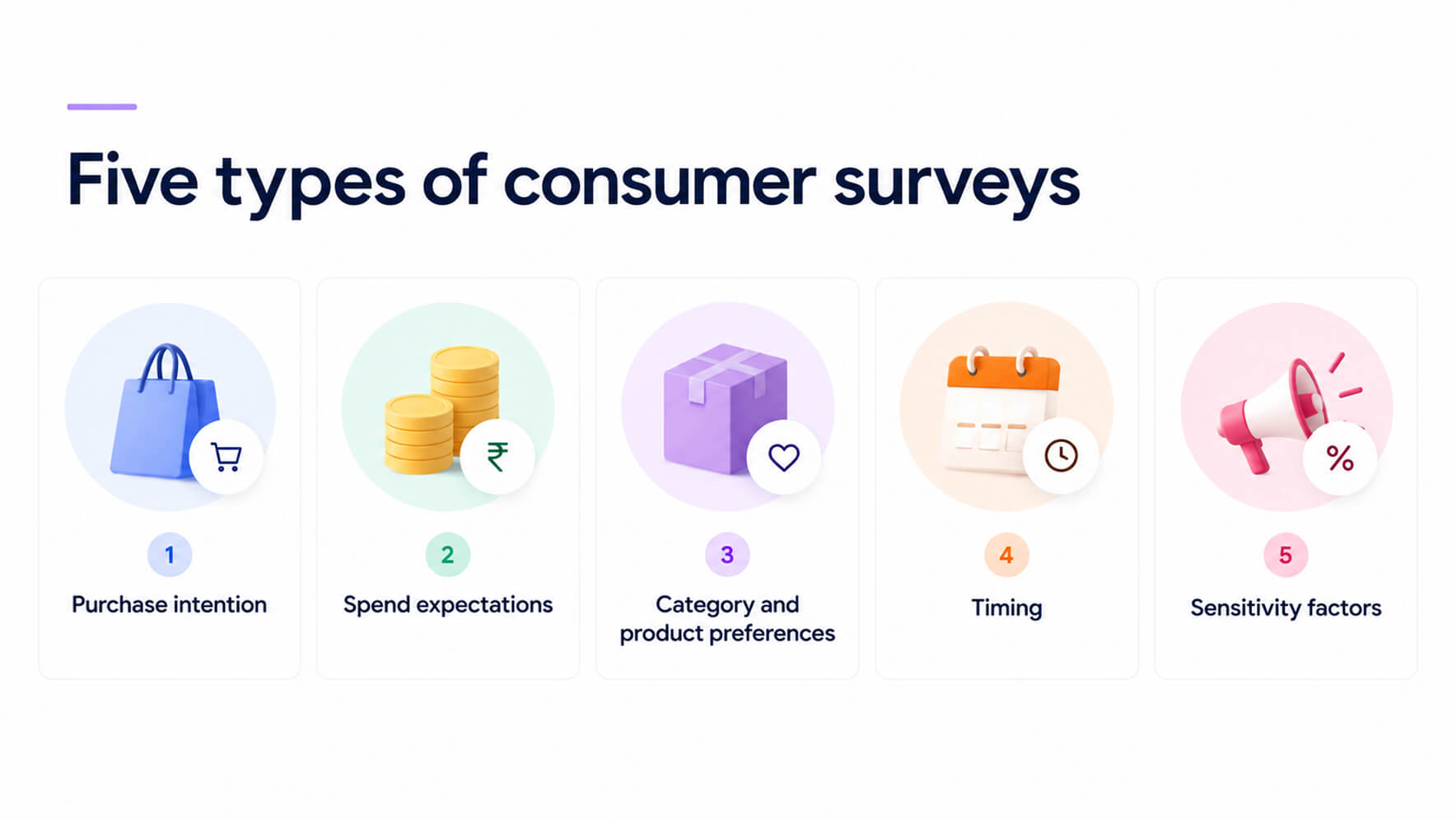
A well-structured consumer survey for seasonal demand forecasting collects five types of information:
- Purchase intention: How likely is the respondent to purchase from this category in the upcoming season? A probability scale, rather than a binary yes/no, yields a more granular demand estimate by allowing planners to weight responses according to their likelihood of converting into actual purchases.
- Spend expectations: How much does the respondent think they will spend on the category during the season? This can help supply chain and inventory teams work out how much stock they might need.
- Category and product preferences: What products, formats, or price points are they most likely to choose? This helps you figure out which parts of the category could see the most demand, which is useful when deciding what to stock.
- Timing: When does the respondent expect to make their purchases? Someone buying early in the season may have very different needs from someone buying during the peak or toward the end, which can affect inventory and promotions.
- Sensitivity factors: Ask what might change their buying plans. Factors like price changes, competitors' offers, product availability, and economic concerns can all affect what they decide to spend.
Seasonal demand examples: how different industries apply consumer surveys
Different industries have different product cycles and consumer preferences. Factors like the timing of conducting the survey, what to ask in it, how to use the data from it, etc., will vary. Here, let us look at how to use consumer surveys for seasonal demand forecasting across multiple industries.
Retail apparel
Six to eight weeks before the holiday season, a mid-market apparel retailer could survey existing customers and people from its target audience. The survey could ask how much they expect to spend on clothing gifts, which categories they are interested in (such as outerwear, accessories, and knitwear), and whether they plan to shop online or in stores. The buying team can then use those answers to adjust the product mix and inventory allocation before orders are locked in.
Consumer electronics
An electronics retailer planning its holiday inventory mix can survey consumers about which device categories they plan to buy or gift, the price tier they are targeting, and whether they are waiting for promotional events like Cyber Monday before purchasing. The timing data alone can significantly improve promotional planning and stock positioning decisions.
Travel and hospitality
A hotel group planning its summer staffing and amenity investments can survey past guests and prospective customers about their summer travel intentions, destination preferences, length-of-stay expectations, and the factors that would influence their decision to book. This is a direct application of the consumer survey method that converts intention data into operational planning inputs.
Food and beverage
Before planning its summer promotions, a consumer packaged goods company can ask customers about their barbecue plans. The survey can cover what they plan to buy, the pack sizes they prefer, and whether they would be willing to try new formats. The answers can then help with both inventory planning and deciding which offers to run.
How to design a consumer survey for seasonal demand forecasting
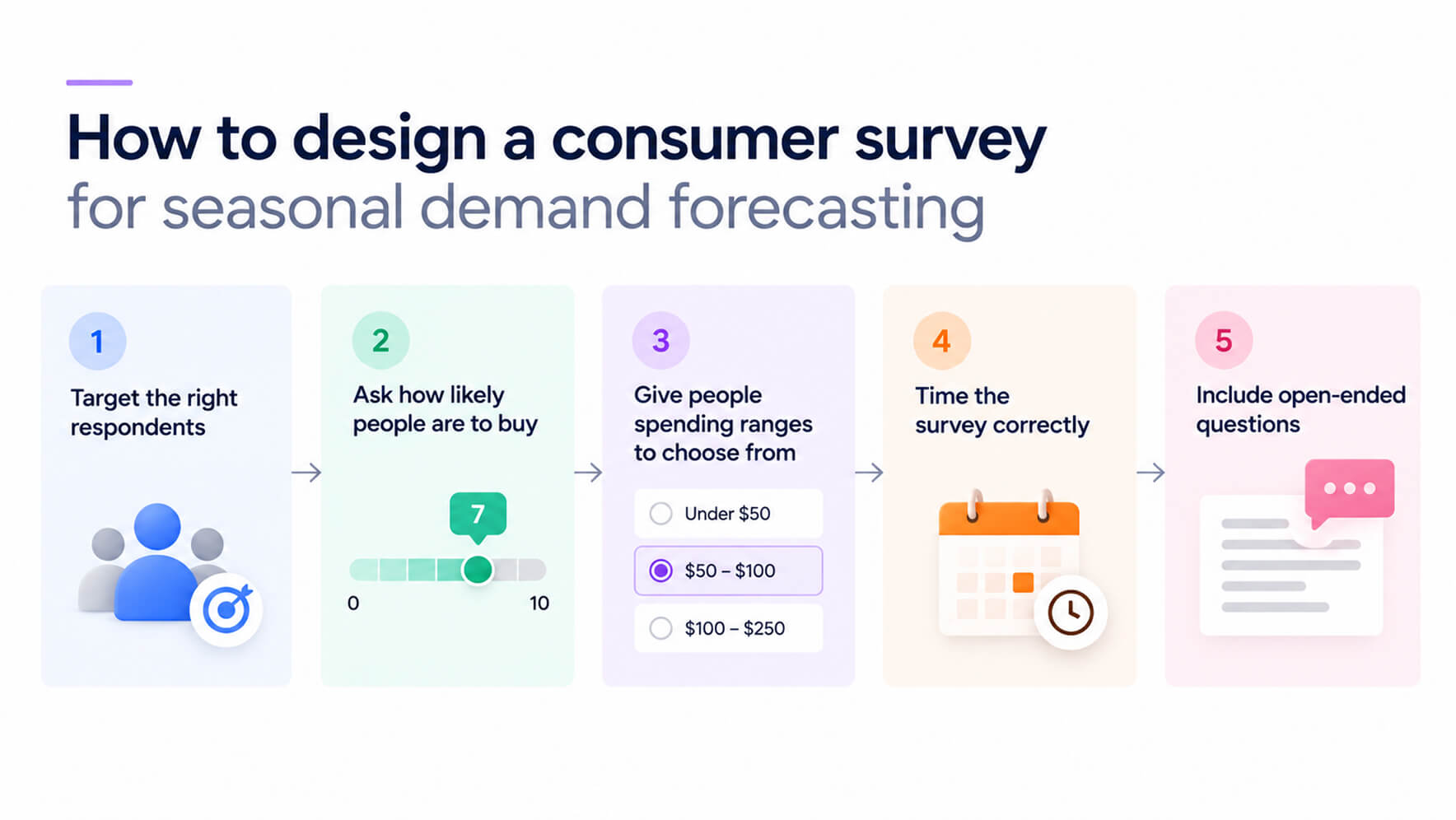
The survey design determines whether the output is usable for planning. A consumer survey that produces aggregate satisfaction scores is not the same as one that produces demand-weighted purchase intention data. In this section, let us look at the different steps involved in designing a consumer survey for seasonal demand forecasting.
- Target the right respondents. The survey should reach people who are likely buyers in the category for the upcoming season. A survey about holiday toy purchasing should reach parents of children under 12. A survey tool feature like quota management ensures the sample reflects the actual buyer population rather than whoever happens to respond.
- Ask how likely people are to buy. A yes-or-no question can make demand look higher because people may say they plan to buy even when they are unsure. Using a 0-to-10 or 0-to-100 scale gives you a better idea of how strong that intention really is.
- Give people spending ranges to choose from. Asking someone to enter an exact amount can lead to inconsistent or unreliable answers. It is easier to compare responses when you give options such as under $50, $50 to $100, $100 to $250, and over $250. These ranges can then be used to estimate possible revenue.
- Time the survey correctly. Too early and consumer intentions have not formed clearly. Too late and the data cannot influence procurement or inventory decisions. For most seasonal categories, eight to twelve weeks before the peak demand window is optimal for running a consumer survey to inform seasonal planning.
- Include open-ended questions. Closed-scale questions produce data that is easy to aggregate. Open-ended questions about what would change the respondent’s purchasing plans or what they are most looking for this season often surface insights that no predefined question anticipated.
From survey responses to a seasonal demand projection
Consumer survey data does not automatically become a forecast. The translation from responses to numbers requires these adjustments:
- Adjust stated intention for the intention-to-behavior gap. Consumers consistently overstate their purchasing intentions. The degree of overstatement varies by category and price point. But applying a category-specific adjustment factor based on historical conversion rates from stated intent to actual purchase brings the survey estimate closer to actual demand.
- Give more weight to people who are more likely to buy. Someone who is almost certain to make a purchase should have more influence on the forecast than someone who is only considering it. Grouping responses by purchase probability and giving each group a different weight can make the demand estimate more realistic.
- Scale the results to the market. Survey responses only represent the people who took the survey. To get a market-level estimate, you need to scale those results to the wider group of potential buyers, while considering how much of that market you can actually reach and distribute to.
- The result is better treated as a range than a single figure. Low, base, and high estimates based on the survey results give inventory and supply chain teams a few realistic scenarios to work with instead of assuming the forecast can be exact.
Running seasonal demand forecasting surveys with Zoho Survey
The operational requirements for consumer survey-based seasonal demand forecasting are specific. The survey needs to reach the right respondents with the right questions (at the right time) and produce results that can be segmented and analyzed quickly enough to influence planning decisions.
Zoho Survey’s quota management features allow demand forecasting surveys to cap responses by demographic segment, ensuring the sample reflects the actual buyer population for the category.
Branching logic routes different respondents to different question paths based on their stated category involvement, preventing irrelevant questions from affecting the quality of responses from genuine category buyers. Cross-tabulation reporting makes it possible to break purchase intention scores and spend estimates down by age group, geography, channel preference, or any other variable collected in the survey, which is where the actionable planning signal usually sits.
When a business runs seasonal consumer surveys across several products or markets, managing everything on a single platform can make the process much easier. Using the same reporting format also means teams can spend less time sorting through data and more time using it for planning.