
Thought leadership is more than sharing opinions or commenting on industry trends. It offers perspectives that help people understand challenges, question assumptions, and make better decisions.
The 2024 Edelman–LinkedIn B2B Thought Leadership Impact Report found that 55% of thought leadership producers identified strong research and data as a characteristic of high-quality thought leadership. For businesses, original research can build credibility by revealing customer concerns, emerging trends, and industry gaps that might otherwise go unnoticed.
Collecting responses alone, however, is not enough. Insight quality depends on asking the right questions, reaching the right audience, and analyzing findings objectively. This guide explains how to design a thought leadership survey and covers everything from setting a research objective to turning evidence into useful, data-backed content.
What is thought leadership?
Thought leadership means sharing original ideas, informed perspectives, and expertise that help an audience understand a topic or solve a problem. It goes beyond repeating familiar industry opinions. Rather, it uses experience, research, and evidence to challenge assumptions and offer a useful point of view. For businesses, effective thought leadership can build credibility and trust.
Why surveys matter for thought leadership
Expert opinions can start a conversation. But research can help test whether those opinions reflect what an audience is experiencing. Surveys let businesses collect firsthand insights from customers, decision-makers, and industry professionals, helping them explore priorities, concerns, and changing expectations. Well-planned thought leadership research can also reveal where common industry assumptions do not match respondents’ experiences.
When the research is designed and interpreted carefully, the findings can inform reports, articles, webinars, and social content. The goal is not simply to confirm what a company already believes but to investigate a genuine knowledge gap.
How to design a thought leadership survey
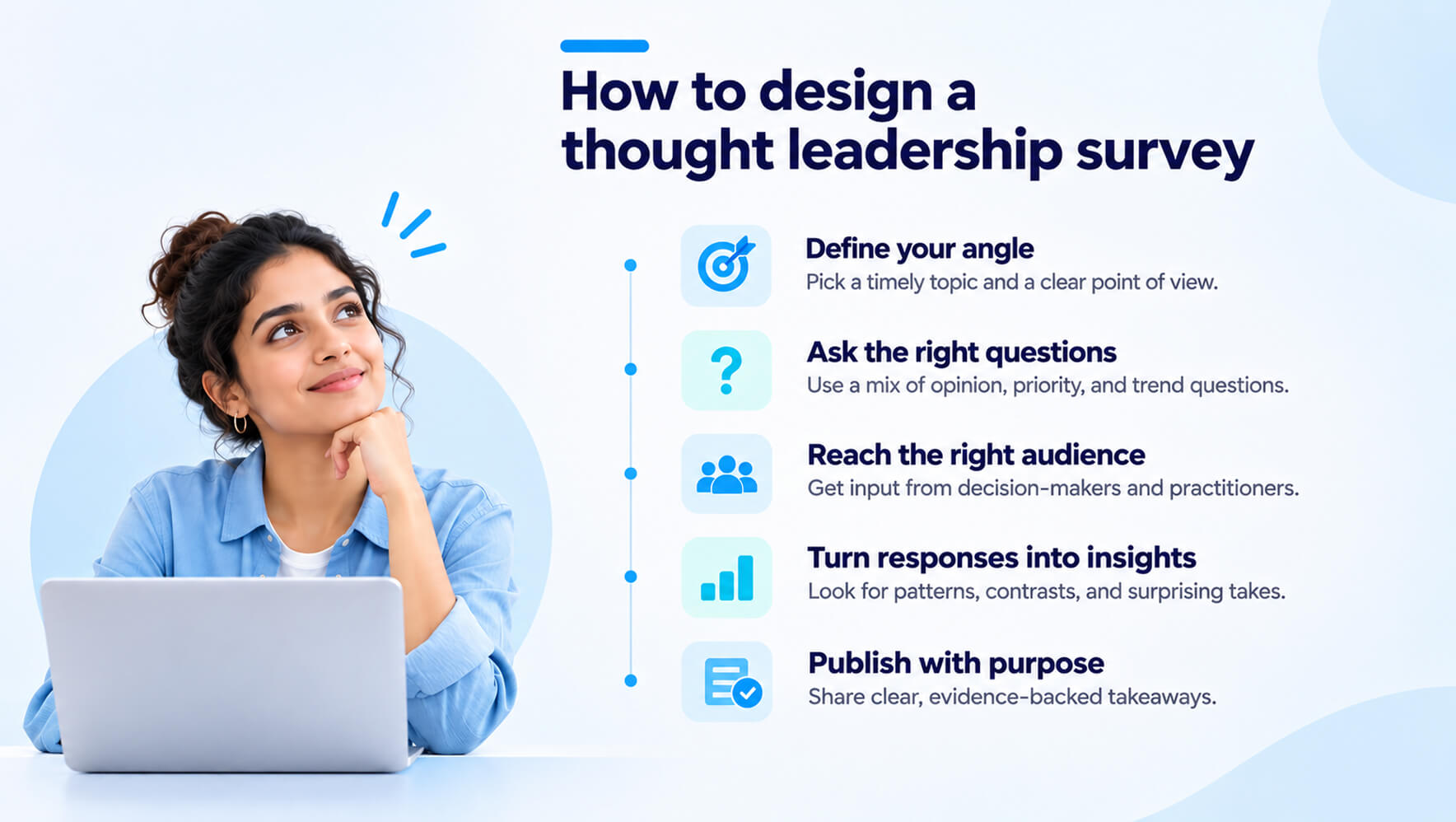
The objective of a thought leadership survey is to uncover something meaningful about an industry, its customers, or changing priorities. Strong industry thought leadership starts with a relevant question and evidence that helps answer it. In this section, you'll find the different steps involved in designing a thought leadership survey.
1. Define your research objective
Identify a specific industry challenge, an unanswered customer question, or an assumption worth examining. For example, a B2B software company like us might want to investigate why organizations struggle to adopt new technology despite investing in digital transformation.
A focused objective keeps the survey relevant and helps you decide which findings are credible and insightful enough to be shared with the external world.
2. Identify your target audience
Your findings are only as relevant as the people who contribute to them. Define the audience based on your research objective by considering:
- Job roles
- Industry
- Company size
- Decision-making responsibilities
For example, a survey about enterprise cybersecurity priorities may need responses from IT leaders and security professionals rather than a general consumer audience.
Zoho Survey’s page logic can route respondents to relevant pages based on their answers, while disqualification logic can direct people who do not meet defined eligibility criteria away from the main questionnaire. This helps keep questions relevant, but it does not by itself guarantee a representative sample. Explore Zoho Survey’s survey logic and personalization features here.
3. Write clear, unbiased questions
Questions should encourage honest responses rather than steer participants toward a preferred conclusion. Avoid leading language, complicated wording, and double-barreled questions that ask about two things at once.
For example, instead of asking, “How effective and affordable is your current marketing technology?” ask separate questions about effectiveness and cost. This makes the answers easier to interpret. This guide on writing clear, unbiased survey questions explains how to avoid this problem.
Use a mix of question types (where appropriate) such as:
- Multiple-choice questions
- Rating scales
- Open-ended questions that let respondents explain their perspectives
4. Choose the right survey format and length
Match the format to the research objective and the time respondents can reasonably give. Keep the questionnaire focused, arrange questions logically, and remove anything that does not contribute to the research goal.
Test the survey with a small group before distributing it. Their feedback can help you spot confusing wording, repetitive questions, or technical issues before the main study begins.
5. Distribute the survey strategically
Reach respondents through channels they already use. Some examples include:
- Professional communities
- Email lists
- Customer networks
- Industry associations
Choose distribution methods based on where your target audience is most likely to participate.
Be transparent about the survey’s purpose and avoid relying on a sample that is too narrow to support your intended conclusions. If you plan to make claims about an entire industry, your sampling method and respondent profile need to support those claims.
Survey quotas can help manage the number of responses overall or within selected groups. But quotas alone do not make a sample representative. Document how respondents were recruited so readers can assess the findings.
How to turn thought leadership research into useful insights
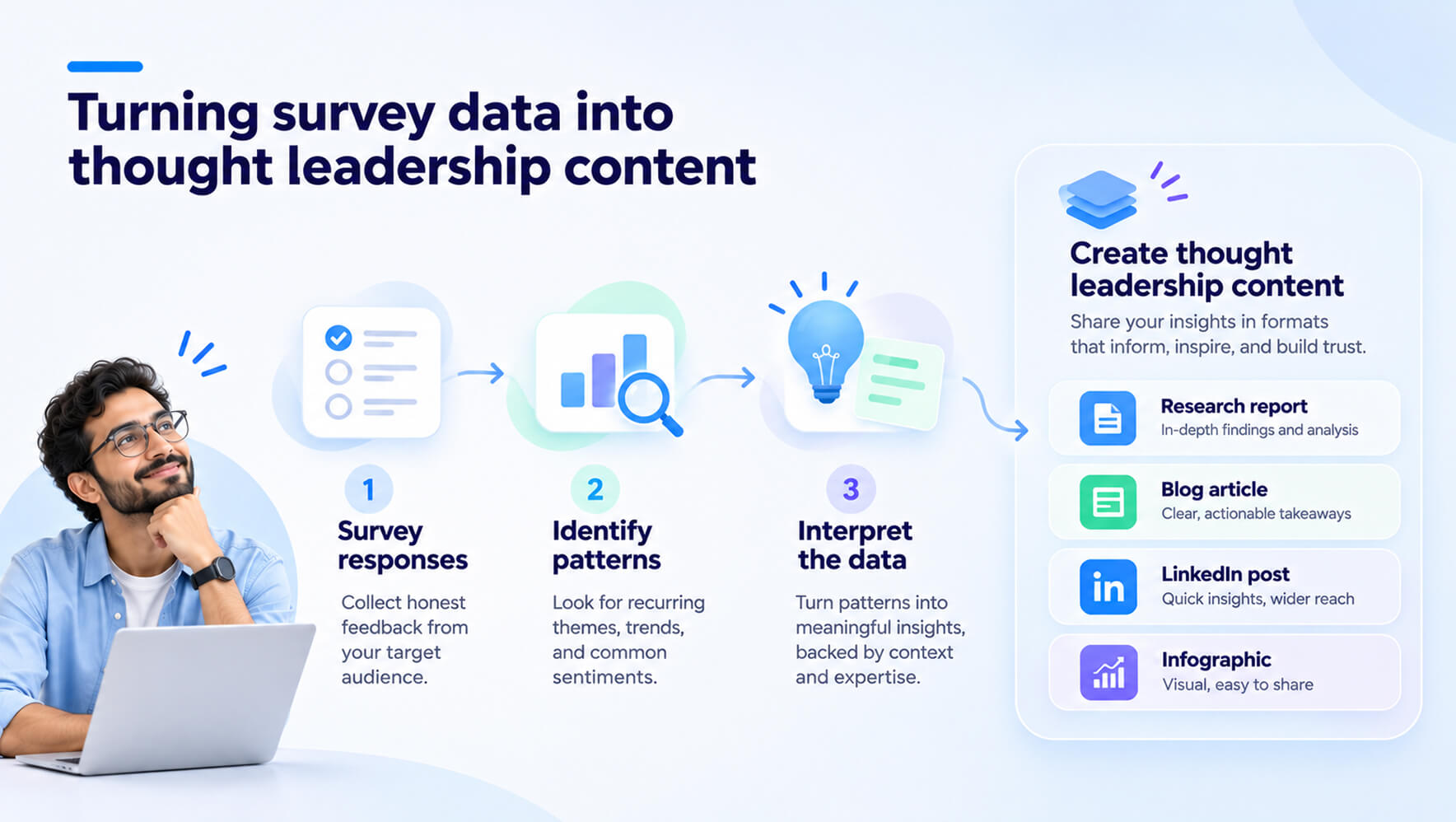
Once responses are collected, look for patterns, unexpected answers, and meaningful differences between groups. For instance, senior leaders may describe AI adoption as a priority while operational teams report difficulty integrating AI tools into daily workflows.
That gap could prompt a deeper discussion about technology adoption and organizational readiness, provided the data supports the interpretation.
Use analysis tools to investigate the results rather than treating every pattern as proof of a wider trend. Zoho Survey offers cross-tab reports to compare answers to two questions and explore possible relationships, trend reports to examine changes over time, and filters to focus on relevant subsets of responses. Its text-analysis options, including sentiment analysis and word clouds, can help organize and explore open-ended answers.
These tools can help surface patterns, but they do not establish why a pattern exists or whether it applies beyond the respondents surveyed. Learn more about analyzing survey data with Zoho Survey and using AI to create and analyze surveys.
You need to clearly distinguish between what the data demonstrates and what you infer from it. Include the sample size, respondent profile, and methodology where relevant, and acknowledge limitations. Avoid presenting a limited or self-selected sample as representative of an entire industry.
Turn findings into content people can use
A strong thought leadership article does more than report percentages. It explains what the findings may mean, why the issue matters to the intended audience, and what decision-makers could consider next. Use specific findings, respondent quotes, and comparisons to support the central argument without overstating the evidence.
Then adapt the research for the formats your audience uses.
A report can explore the findings in depth, a blog post can explain their implications, a LinkedIn post can highlight one takeaway, and an infographic can make comparisons easier to understand.
For more ideas on connecting research with a content strategy, explore Zoho Survey’s guide to content marketing surveys. Each format should offer a clear takeaway instead of simply repeating the same statistics.
The aim is to create thought leadership insights that help readers understand a problem more clearly, question an established approach, or make a better-informed decision. When research offers that kind of value, it becomes a credible contribution to the industry conversation.
Conclusion
A well-designed thought leadership survey can help businesses uncover perspectives that go beyond conventional industry commentary. Start with a clear objective, define the right audience, write unbiased questions, and distribute the survey carefully. Then, analyze the findings objectively and explain why they matter.
The goal here is to understand what the evidence reveals and how it can help an audience make better decisions. Research handled with curiosity and methodological care can produce thought leadership content that contributes something meaningful to an industry.
Ready to discover what your audience cares about?
Create a survey with Zoho Survey and start turning responses into evidence-informed insights.